
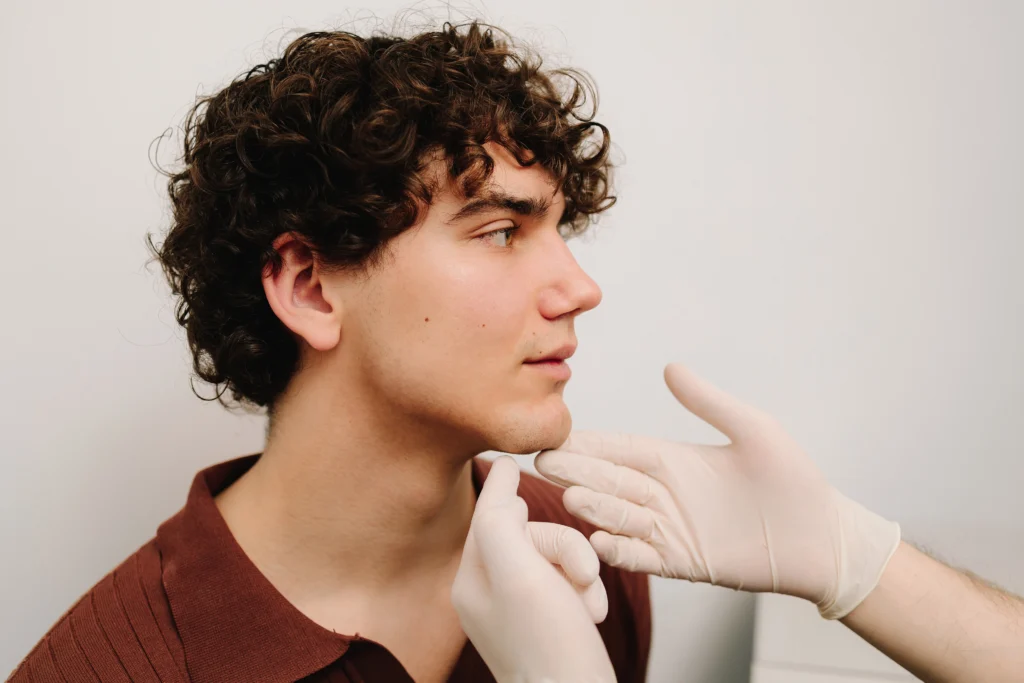
Custom cheekbone implants can change more than how prominent your cheeks look. Depending on their shape and placement, they can increase forward projection, add width to the upper face or change the contour below the eyes. Two implants with similar dimensions can produce different appearances when placed in different parts of the cheek. [1] [2] [3]
This makes cheekbone augmentation a matter of anatomy and facial proportions. Someone with naturally flat cheekbones may want greater definition, while another person may be concerned about asymmetry or a recessed midface. The proposed implant should address the specific area that needs augmentation. [1] [3]
Key takeaways
- Malar implants augment the upper cheekbone prominence, while submalar implants add volume lower in the cheek.
- Forward projection and lateral width produce different changes in facial shape.
- Custom designs can account for skeletal contours and asymmetry, although direct comparisons with standard implants remain limited.
- Infection, sensory changes, displacement and visible implant edges are possible complications.
Understanding cheekbone anatomy
Where the cheekbone gets its shape
The cheekbone, or zygomatic bone, forms the prominent part of the upper cheek and contributes to the outer wall of the eye socket. It connects with the upper jaw and extends toward the ear through the zygomatic arch. [2]
The visible cheek also depends on the fat, muscle and skin covering these bones. Two people with similar skeletal structures may therefore have different cheek contours because their soft-tissue volume differs. [4]
Malar versus submalar augmentation
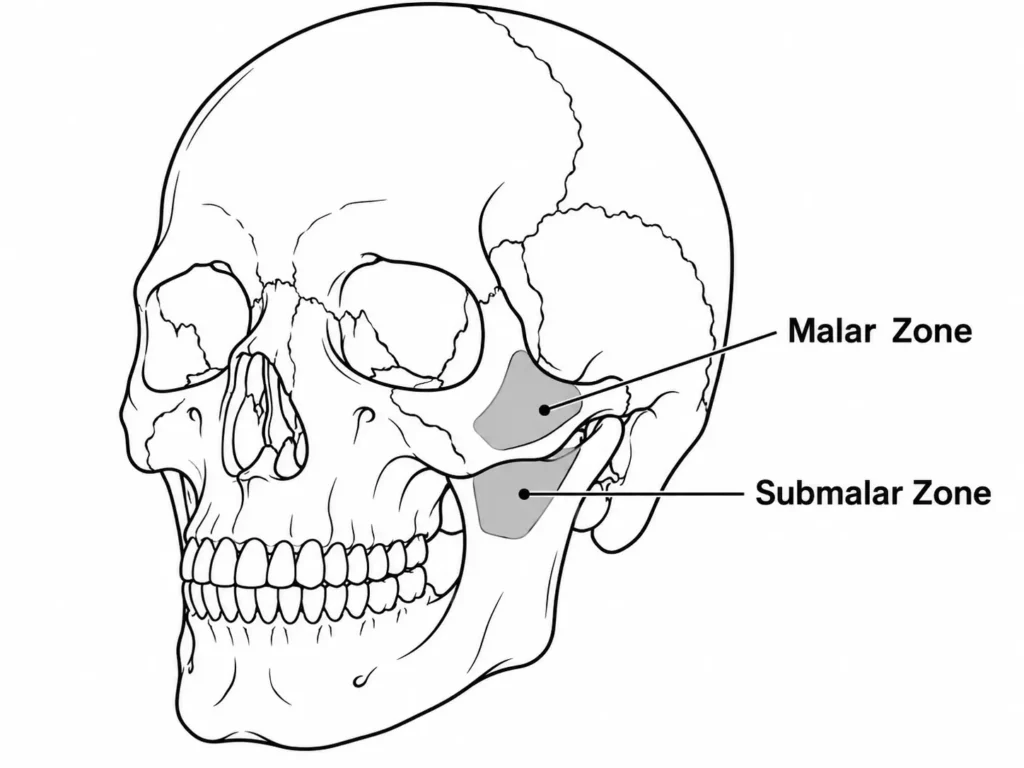
The main difference is where the volume is added.
Malar implants sit over the cheekbone prominence, generally higher and more lateral on the face. Submalar implants are positioned lower, over the anterior maxilla beneath the cheekbone prominence. Combined implants cover both regions. [2]
Malar augmentation can make the cheekbones more pronounced, while submalar augmentation addresses fullness below the cheekbone. The appropriate location depends on the patient’s anatomy and intended correction.
Mladick described assessing whether a cheek deficiency is mainly anterior-medial, posterior-lateral or combined before selecting an implant. [3]
Forward projection versus facial width
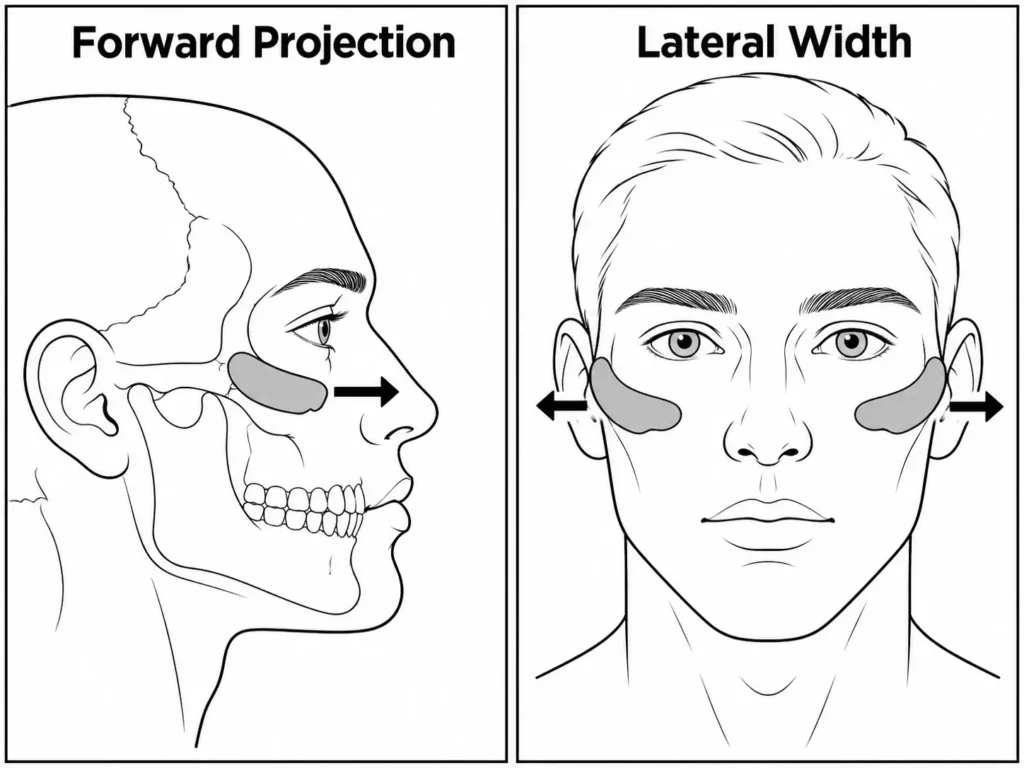
How the direction of augmentation changes the result
Adding more volume does not always produce the desired contour. The direction of augmentation matters too.
Anterior cheek projection increases prominence toward the front of the face. Lateral augmentation adds volume toward the sides and can increase facial width. [1] [3]
An implant concentrated over the front of the malar region may make the cheeks appear more projected in profile. Extending augmentation toward the outer cheekbone can change the frontal outline.
A 2026 systematic review of 15 studies involving 796 patients examined malar implant placement and surgical outcomes. The authors recommended targeting the central malar prominence while avoiding excessive lateral augmentation. This was a planning recommendation based on the reviewed literature, not a clinically established ideal dimension. [1]
Front, profile and three-quarter views
The same cheek implant can look different from each angle.
From the front, increased lateral width may be the most noticeable change. The profile shows forward projection, while the three-quarter view reveals how the cheekbone transitions toward the nose and lower cheek. [1] [3]
A patient may like the added width in a frontal view but find the forward projection excessive. Reviewing multiple views helps identify these differences before surgery.
Facial Nexus can coordinate a design discussion with an independent implant designer, allowing patients to explain their preferences before the operating surgeon evaluates the proposal.
The cheekbones and under-eye area
The upper cheek is connected to the infraorbital region
The cheekbones sit below and beside the eye sockets. The infraorbital rim forms the lower border of each socket and connects with the surrounding midface skeleton. [2]
An implant extending into the upper malar or infraorbital region can alter the contour below the eyes. The change depends on which anatomical areas the implant covers. It does not mean that cheek augmentation will correct every type of under-eye hollow.
Some patients have skeletal deficiencies involving several neighboring regions.
In a 2026 retrospective study, Wang and colleagues evaluated patient-specific PEEK implants for concavity affecting multiple midface areas, including the infraorbital and malar regions. The study included 31 patients and reported favorable short-term outcomes. The authors also acknowledged the need for larger comparative studies and longer follow-up. [5]
Soft-tissue volume versus skeletal augmentation
Why fillers and implants produce different changes
A cheek can appear flat because of limited skeletal projection, reduced soft-tissue volume or both.
Fillers and fat grafting add volume within the soft tissues. An implant is positioned against the facial skeleton and changes the underlying contour that supports those tissues. [2] [4]
The appropriate treatment depends on where the deficiency lies.
Lam reviewed fillers, fat grafting and implants as options for facial volumization. The review described fillers and fat grafting as useful for soft-tissue volume loss, while implants were considered particularly suitable for skeletal deficiencies or patients with sufficient soft-tissue coverage. [4]
Someone whose main concern is soft-tissue volume loss may not need a cheekbone implant. Conversely, adding soft-tissue volume may not provide the same structural change as augmenting a deficient cheekbone.
Custom cheekbone implants versus standard implants
What changes with a patient-specific design?
Standard cheek implants come in predefined shapes and sizes. Surgeons can select an appropriate design and may adjust it during surgery. [2]
Custom cheekbone implants are designed around the patient’s three-dimensional skeletal anatomy. Their thickness, distribution of volume and borders can be adjusted according to the intended correction. [6] [5]
The left and right sides can also have different shapes when skeletal asymmetry requires it.
Narciso and colleagues described a 50-year-old patient who had undergone three previous procedures involving silicone cheek implants. He remained dissatisfied with facial symmetry and could feel the implant margins beneath the lower-eyelid skin.
The surgeons replaced the existing silicone implants with custom PEEK implants designed using three-dimensional CT imaging. The authors reported a satisfactory result without complications during the documented follow-up. However, this was a single case and cannot establish that custom PEEK implants consistently outperform standard implants. [6]
Facial Nexus can connect patients with an independent implant designer and surgeon to discuss these options and coordinate non-medical arrangements.
Read more about how custom facial implants are designed.
Material choices, including PEEK
Cheek implants can be manufactured from several materials, including silicone, porous polyethylene and PEEK. These materials differ in rigidity, tissue interaction and available manufacturing methods. [2] [6] [7]
PEEK cheek implants can be produced from computer-assisted designs based on the patient’s anatomy. Published clinical reports describe their use for malar augmentation and more extensive midface correction. [6] [5]
Silicone and porous polyethylene are established facial implant materials. A 2018 literature review evaluated complications associated with these two materials but did not directly compare them with PEEK. [7]
No material guarantees a better aesthetic result. The surgeon must consider the anatomy, desired contour, fixation requirements and relevant risks.
Who might consider custom cheekbone implants?
Different concerns require different designs
Patients may consider midface augmentation because of naturally flat cheekbones, skeletal asymmetry or limited projection in a particular region.
Others want greater definition across the upper face or are dissatisfied with earlier cheek implant surgery. Published studies describe patient-specific implants used for both primary augmentation and revision procedures. [6] [5]
The surgeon should determine whether the concern is mainly skeletal, involves soft-tissue volume or requires a different treatment approach.
Avoiding excessive projection and complications
Why more augmentation can become a problem
Increasing cheekbone size beyond the intended proportions may produce an excessively prominent or wide midface.
The 2026 review by Kauke-Navarro and colleagues recommended careful positioning around the central malar prominence to avoid excessive lateral augmentation. [1]
Implant position also affects the result. Displacement or poorly matched contours can produce asymmetry or visible irregularities.
Rojas and colleagues reviewed complications involving silicone and porous polyethylene facial implants. They reported infection, displacement, exposure and implant prominence. The review found more infections and displacements in the silicone group, while prominence problems were more frequent with porous polyethylene. These findings should not be generalized to all facial implant materials. [7]
Sensory changes are another consideration. In Wang and colleagues’ 31-patient PEEK midface series, 12 patients experienced temporary reduced sensation in the upper-lip or infraorbital region, which resolved within three months. One patient later underwent implant removal because of dissatisfaction with its size. The findings came from a small series with limited follow-up. [5]
Custom planning can help define implant geometry and intended fixation, but it cannot prevent every complication.
The bottom line
Custom cheekbone implants can alter cheek projection, facial width and the contours connecting different parts of the midface. The result depends on the anatomical area being augmented, the implant design and its placement.
Malar, submalar and combined augmentation address different contour problems. Careful assessment of the skeleton and soft tissues helps determine which approach is appropriate.
Facial Nexus can coordinate your connection with an independent implant designer and qualified surgeon to explore a patient-specific design. The surgeon remains responsible for medical assessment and surgical treatment.
Contact Facial Nexus to discuss the available options.
Frequently asked questions
Do cheekbone implants make your face wider?
They can. Implants extending toward the sides of the cheekbones may increase facial width. Designs focused on the central or anterior malar region primarily address forward cheek projection.
What is the difference between malar and submalar implants?
Malar implants augment the higher cheekbone prominence. Submalar implants add volume below that area, over the anterior maxilla. Combined implants cover both regions.
Can custom cheekbone implants correct facial asymmetry?
They can be designed with different dimensions on each side to address skeletal differences. The surgeon must first determine whether the asymmetry comes from bone, soft tissue or both.
Are PEEK cheekbone implants better than silicone?
Current clinical evidence does not establish that PEEK is universally better than silicone. PEEK can be manufactured into patient-specific shapes, while silicone is available in established implant designs. The appropriate choice depends on anatomy, surgical requirements and individual treatment goals.
References
- Kauke-Navarro M, Knoedler L, Klimitz FJ, Diatta F, Kong V, Bigus S, et al. Strategies for malar implant placement: a review of access, planning, and outcomes. Plast Reconstr Surg Glob Open. 2026;14(4). doi:10.1097/GOX.0000000000007554. PubMed
- Schatz CJ, Ginat DT. Imaging of cosmetic facial implants and grafts. AJNR Am J Neuroradiol. 2013;34(9):1674-1681. doi:10.3174/ajnr.A3214. PubMed
- Mladick RA. Alloplastic cheek augmentation. Clin Plast Surg. 1991;18(1):29-38. PubMed
- Lam SM. Integrating injectable fillers and fat in facial rejuvenation. Facial Plast Surg. 2015;31(1):35-42. doi:10.1055/s-0035-1544245. PubMed
- Narciso R, Basile E, Bottini DJ, Cervelli V. PEEK implants: an innovative solution for facial aesthetic surgery. Case Rep Surg. 2021;2021:5518433. doi:10.1155/2021/5518433. PubMed
- Rojas YA, Sinnott C, Colasante C, Samas J, Reish RG. Facial implants: controversies and criticism. A comprehensive review of the current literature. Plast Reconstr Surg. 2018;142(4):991-999. doi:10.1097/PRS.0000000000004765. PubMed
- Wang X, Wu S, Wang M, Wu T, Zheng X, Li F, et al. Integrated polyetheretherketone patient-specific implants for multi-subunit midface concavity: a retrospective case series. Front Surg. 2026;13:1868881. doi:10.3389/fsurg.2026.1868881. PubMed

References
- Kauke-Navarro M, Knoedler L, Klimitz FJ, Diatta F, Kong V, Bigus S, et al. Strategies for malar implant placement: a review of access, planning, and outcomes. Plast Reconstr Surg Glob Open. 2026;14(4). doi:10.1097/GOX.0000000000007554.[↩][↩][↩][↩][↩][↩]
- Schatz CJ, Ginat DT. Imaging of cosmetic facial implants and grafts. AJNR Am J Neuroradiol. 2013;34(9):1674-1681. doi:10.3174/ajnr.A3214.[↩][↩][↩][↩][↩][↩][↩]
- Mladick RA. Alloplastic cheek augmentation. Clin Plast Surg. 1991;18(1):29-38.[↩][↩][↩][↩][↩]
- Lam SM. Integrating injectable fillers and fat in facial rejuvenation. Facial Plast Surg. 2015;31(1):35-42. doi:10.1055/s-0035-1544245.[↩][↩][↩]
- Wang X, Wu S, Wang M, Wu T, Zheng X, Li F, et al. Integrated polyetheretherketone patient-specific implants for multi-subunit midface concavity: a retrospective case series. Front Surg. 2026;13:1868881. doi:10.3389/fsurg.2026.1868881.[↩][↩][↩][↩][↩]
- Narciso R, Basile E, Bottini DJ, Cervelli V. PEEK implants: an innovative solution for facial aesthetic surgery. Case Rep Surg. 2021;2021:5518433. doi:10.1155/2021/5518433.[↩][↩][↩][↩][↩]
- Rojas YA, Sinnott C, Colasante C, Samas J, Reish RG. Facial implants: controversies and criticism. A comprehensive review of the current literature. Plast Reconstr Surg. 2018;142(4):991-999. doi:10.1097/PRS.0000000000004765.[↩][↩][↩]