

Most discussions about facial surgery focus on appearance and the social consequences of facial surgery. Patients talk about a stronger jawline, a more prominent chin, better symmetry, or a more balanced facial profile. But there is another question worth asking before surgery: how might these changes affect the way other people see you?
We form impressions of people long before we get to know them. A face can appear friendly, intimidating, confident, or reserved, even when those impressions have little to do with the person’s actual personality.
Research by Oosterhof and Todorov found that many judgments based on facial appearance can be described along two broad dimensions: trustworthiness and dominance. These judgments are often automatic, but they are not necessarily accurate. [1]
For someone considering facial surgery, this raises an interesting point. Changing facial proportions may also change the first impression a face creates, although the social consequences are far less predictable than the physical changes themselves.
Key takeaways
- Facial surgery can influence how others perceive your appearance.
- A more masculine or feminine face is not necessarily more attractive.
- Balanced facial proportions are essential for natural-looking results.
- 3D planning helps create personalized changes with realistic expectations.
How masculinity and femininity shape first impressions
Consider a man who wants a broader, more angular jaw. Procedures such as jaw angle augmentation, chin advancement, or custom facial implants can change the contours of the lower face.
The motivation may be purely aesthetic. Perhaps he feels his chin is too small, or his jaw lacks definition. But facial shape also plays a role in how masculinity and dominance are perceived.
In their research on facial evaluation, Oosterhof and Todorov found that dominance judgments were particularly sensitive to facial characteristics associated with physical strength and maturity. [1]
That does not mean a stronger-looking jaw makes someone more confident or dominant. It simply means certain facial characteristics can influence how observers interpret a face.
The same distinction matters when considering feminine facial features. Softer contours and different facial proportions may contribute to a more feminine appearance, while angular features may produce a different impression.
Neither direction is inherently better. A person might prefer a delicate appearance, a pronounced facial structure, or something between the two.
More importantly, appearance does not reveal someone’s character. An angular face is not evidence of an aggressive personality, just as a softer face does not prove someone is more trustworthy.
A more masculine face is not necessarily more attractive
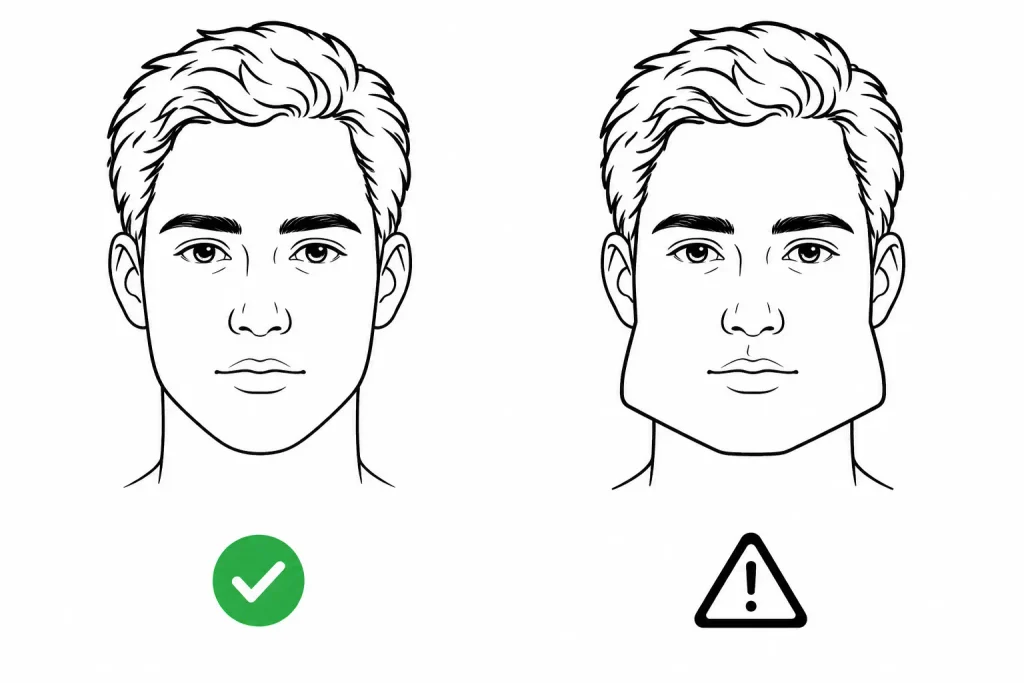
It is easy to assume that making a facial feature more pronounced will improve attractiveness.
A wider jaw must look better than a narrow one. A sharper chin must be preferable to a rounded one. More definition must mean a better result.
But attractiveness is not that straightforward.
A study published in PLOS ONE examined the relationship between male facial masculinity and attractiveness. Using measurements of facial shape, the researchers found no relationship between morphological masculinity and rated attractiveness in the samples they studied. [2]
This challenges the idea that increasing traditionally masculine characteristics automatically makes a face more attractive.
Imagine someone requesting a considerably wider jaw after seeing a photograph of a model. The feature may look appealing in that particular face, but it might not have the same effect when applied to different facial proportions.
The relationship between the chin, jaw angles, cheekbones, nose, and forehead matters.
A prominent jaw can look balanced on one person and disproportionate on another. Even a relatively small change in chin projection may alter how the nose and lower face appear in profile.
This is why copying another person’s facial proportions is rarely a useful surgical objective. The better question is whether the proposed change suits the individual’s existing anatomy.
The uncanny valley: when facial proportions feel unusual
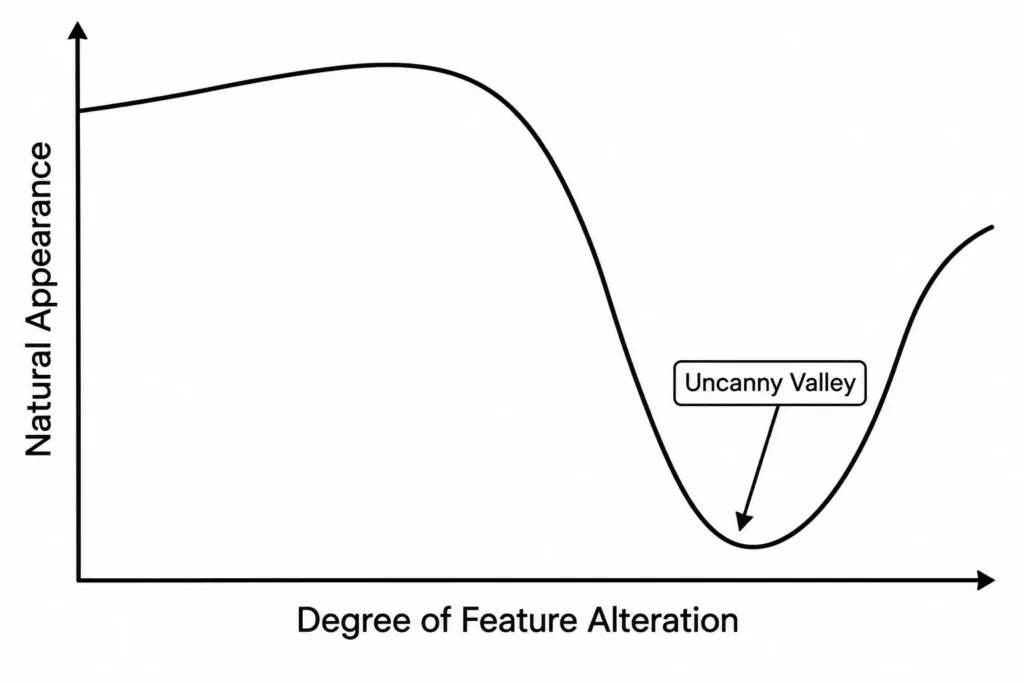
There is an interesting concept from robotics that can help explain why a face sometimes looks unusual despite having individually attractive features. It is called the uncanny valley.
The term was introduced by Japanese roboticist Masahiro Mori in 1970. He proposed that as robots become increasingly humanlike, they may reach a point where their appearance creates discomfort rather than familiarity. His original essay was later published in English in IEEE Robotics & Automation Magazine. [3]
The concept was developed to describe reactions to artificial humanlike figures, not patients undergoing facial surgery. Applying it to aesthetic surgery is therefore an analogy, not an established medical explanation.
Still, it offers an interesting way to think about facial proportions.
Imagine a face with extremely prominent cheekbones, an unusually wide jaw, and a strongly projected chin. Each feature might be desirable on its own. Together, however, the proportions may create an appearance that feels unusual to some observers.
The problem is not necessarily the size of any single feature. It may be the relationship between them.
That does not mean dramatic facial changes are undesirable. Some patients deliberately prefer distinctive or highly angular features, and their preferences should be respected.
But for someone seeking a natural-looking result, the transitions between facial structures deserve as much attention as the individual measurements.
Importantly, there is no established evidence that the uncanny-valley effect specifically explains how people react to surgically altered faces.
What impression do you actually want to create?
Patients often describe their goals using broad expressions:
- “I want a stronger jawline.”
- “I want my face to look more masculine.”
- “I want softer features.”
These requests are useful starting points, but they leave considerable room for interpretation.
For one person, a stronger jawline might mean slightly better definition beneath the ears. For another, it might mean substantially increasing the width of the lower face.
The difference matters because both patients could request the same procedure while expecting very different results.
Before discussing how many millimeters of projection or width to add, it is worth exploring what the patient likes about a particular facial appearance.
Is the goal to correct a perceived imbalance? Create a more mature appearance? Add definition while keeping the overall face relatively unchanged?
Patients may also hope their appearance will influence how others perceive them. That expectation deserves an open discussion, but it should not become a promise.
Research shows that people make personality judgments from facial appearance despite limited evidence that these judgments accurately reflect personality. [4]
A surgical change cannot guarantee that someone will seem more authoritative, approachable, or attractive to everyone they meet.
Why three-dimensional planning matters
One of the challenges in facial surgery is that changing one area can affect the apparent proportions of another.
Consider jaw angle augmentation. Increasing the width of the lower face changes its relationship with the cheekbones and chin. Similarly, advancing the chin can alter the balance of the facial profile.
These relationships are difficult to evaluate by considering each structure separately.
Three-dimensional imaging and virtual planning can help surgeons assess skeletal anatomy, evaluate proposed changes, and communicate treatment plans.
A 2024 systematic review examined the accuracy of three-dimensional soft-tissue simulations in orthognathic surgery. Across 40 included studies, reported mean simulation errors for the whole face ranged from 0.27 to 2.9 mm. Accuracy varied between anatomical regions and procedures. [5]
These findings highlight both the usefulness and the limitations of digital planning.
A simulation can provide a visual estimate of a proposed result, but it cannot reproduce every detail of healing or predict the final appearance with complete certainty.
It also cannot tell a patient how friends, colleagues, or strangers will respond to their new appearance.
For patients considering custom facial implants or osteotomies, three-dimensional planning is valuable because it allows the proposed structural changes to be discussed in relation to the entire face.
However, the precision of a digital design should never be confused with a guarantee of the eventual aesthetic or social outcome.
Choosing a result that fits you
There is no universally ideal jaw width, chin projection, or cheekbone prominence.
One person may want a subtle improvement that is barely noticeable to others. Another may prefer a more pronounced transformation.
Both are legitimate aesthetic preferences.
What matters is understanding the intended change, its anatomical implications, and the limits of what surgery can realistically achieve.
At FacialNexus, we connect patients with an independent implant designer and an independent maxillofacial surgeon for assessment of potential custom facial implant and osteotomy procedures.
The independent surgeon is responsible for medical evaluation, treatment decisions, surgery, and postoperative care.
Our role is to help patients connect with the relevant professionals and coordinate non-medical aspects of the process.
The objective is not to encourage the widest possible jaw or the most prominent cheekbones. It is to help patients explore options that reflect their anatomy, personal preferences, and desired degree of change.
The bottom line
Facial surgery is about more than changing measurements on a CT scan.
The face plays an important role in how we recognize ourselves and how others initially perceive us. Changing its structure may influence those impressions, but the effects are subjective and cannot be reliably predicted.
A broader jaw does not guarantee greater respect. A more feminine appearance does not guarantee that someone will seem more approachable. And an aesthetically successful operation does not necessarily change a person’s social experiences in the way they expected.
Before surgery, patients should consider not only which features they want to change, but also why those changes matter to them.
The most useful consultation is one that connects aesthetic preferences with realistic expectations, anatomical considerations, and a clear understanding of what surgery can and cannot accomplish.

References
- Oosterhof NN, Todorov A. The functional basis of face evaluation. Proc Natl Acad Sci U S A. 2008;105(32):11087-11092. doi:10.1073/pnas.0805664105.[↩][↩]
- Scott IML, Pound N, Stephen ID, Clark AP, Penton-Voak IS. Does masculinity matter? The contribution of masculine face shape to male attractiveness in humans. PLoS One. 2010;5(10). doi:10.1371/journal.pone.0013585.[↩]
- Mori M, MacDorman KF, Kageki N. The uncanny valley [from the field]. IEEE Robot Autom Mag. 2012;19(2):98-100. doi:10.1109/MRA.2012.2192811.[↩]
- Todorov A, Said CP, Engell AD, Oosterhof NN. Understanding evaluation of faces on social dimensions. Trends Cogn Sci. 2008;12(12):455-460. doi:10.1016/j.tics.2008.10.001.[↩]
- Olejnik A, Verstraete L, Croonenborghs TM, Politis C, Swennen GRJ. The accuracy of three-dimensional soft tissue simulation in orthognathic surgery: a systematic review. J Imaging. 2024;10(5):119. doi:10.3390/jimaging10050119.[↩]