

The question often comes up as PEEK vs titanium facial implants, which is better? Unfortunately, there is no clear cut winner based on current literature. Patient specific craniofacial implants can be made from either material however they have different mechanical properties, biology, and imaging appearance. [1] [2]
PEEK has lower stiffness and is radiolucent. Titanium is stiffer and has documented osseointegration. A recent 2026 systemic review states that the choice of material should therefore be dictated by anatomical location, imaging requirements and planned revision hardware rather than preference for a material. [1] [2]
FacialNexus helps patients explore custom PEEK facial implants by connecting them with an independent implant designer and qualified surgeon. Together, they can assess whether PEEK is appropriate for your facial anatomy and aesthetic goals..
Key takeaways
- PEEK facial implants and titanium facial implants can both be designed using three-dimensional anatomical data and computer-aided manufacturing.
- PEEK has lower stiffness and density than titanium. Titanium has greater rigidity and established bone integration.
- Unmodified PEEK has limited bioactivity. Surface modifications are being investigated to improve its interaction with bone and soft tissues.
- A 2026 systematic review found no statistically significant difference between PEEK and titanium in overall complications, infection, implant removal, or healing-related complications.
- Material selection should account for anatomy, imaging requirements, and possible revision surgery.
What are PEEK and titanium?
Two different implant materials
PEEK is short for polyetheretherketone which is a high-performance thermoplastic polymer used in oral and maxillofacial surgery. It has bone-like elastic modulus, is radiolucent, has excellent fatigue strength and is used in patient-specific reconstruction. [2]
Titanium is metal utilized in craniofacial surgery because of its strength, corrosion resistance, and biocompatibility. Titanium has also been used in patient specific jawline implants. [2] [3]
These two materials both allow for contouring using computer aided design and computer aided manufacturing techniques. Though their properties differ there are different approaches, the implant must still be designed according to anatomy and desired correction. [4] [3]
Strength, rigidity, and weight
PEEK is less rigid than titanium
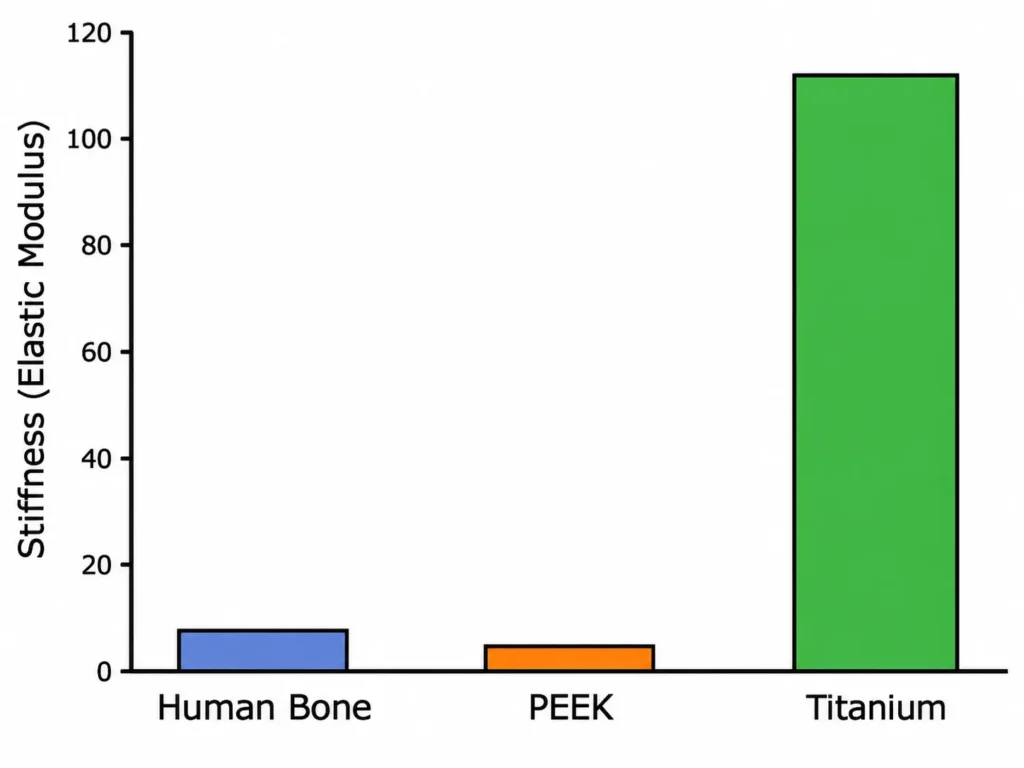
One of the main differences is stiffness. The 2026 review reported an elastic modulus of approximately 3–4 GPa for PEEK and 110 GPa for titanium alloy. For comparison, the same review listed cortical bone at approximately 14 GPa. [2]
PEEK also has a lower density. The review reported approximately 1.3 g/cm³ for PEEK and 4.5 g/cm³ for titanium alloy. This means the materials differ in weight when compared at the same volume. [2]
Titanium’s higher stiffness provides mechanical strength, while PEEK’s elastic behavior is closer to that of bone. Neither property establishes one material as the better option for every facial implant. [1] [2]
If you’re considering custom PEEK facial implants, FacialNexus can connect you with an independent designer and surgeon to explore how this material could fit your facial augmentation goals.
Bone and tissue interaction
Titanium has established osseointegration
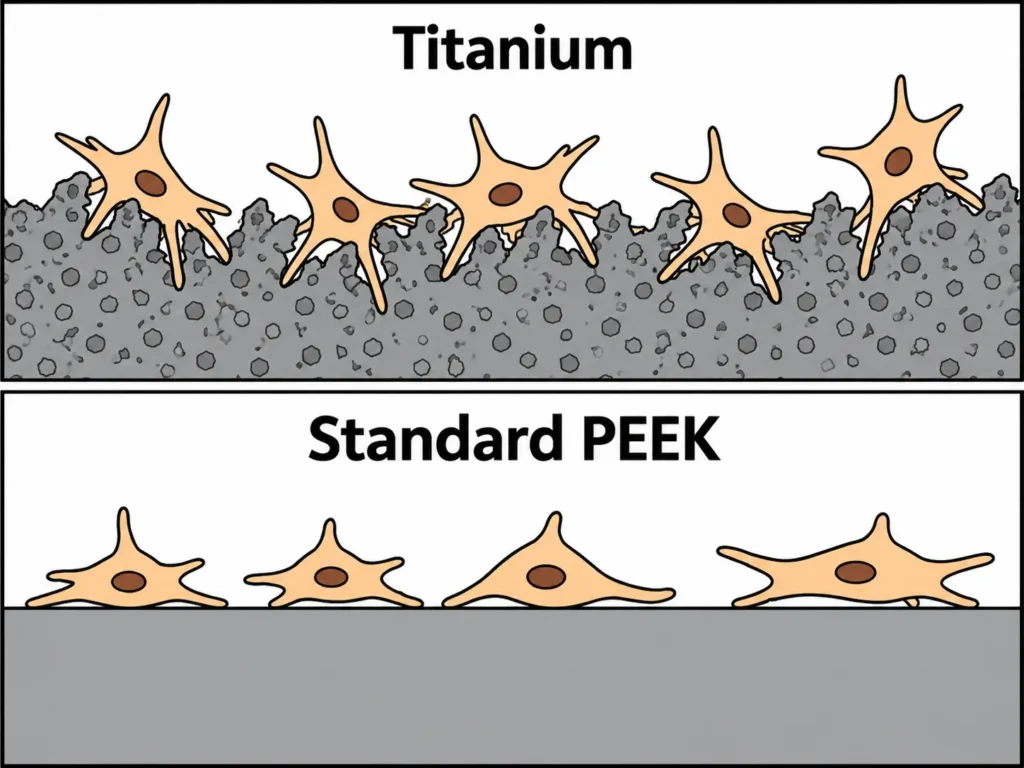
Titanium has an established ability to integrate with bone. This is one of the material characteristics discussed in the 2026 comparison of PEEK and titanium implants. [1] [2]
Patient-specific titanium implants can also incorporate porous structures at the bone-contact surface. Mommaerts described titanium jawline implants with scaffolds on the bony contact side and reported bone formation in porous channels in a preclinical model. [3]
Standard PEEK has limited bioactivity
Standard PEEK is bioinert and therefore does not readily integrate with bone tissue. Attempts at hydroxyapatite and titanium coatings as well as plasma treatment and other surface modifications have been studied to improve tissue response. [2] [5] [6]
One review from 2023 notes improved osseous and soft-tissue binding in benchtop and small animal models, however concluded that longer-term clinical studies are needed. [5]
Another review from 2024 analysed 32 articles and included 194 patients but noted there were no clinical reports from the searched literature that evaluated surface-modified PEEK in facial skeleton surgery. [6]
One study including 28 patients from 20 23 performed CT scans on three patients that demonstrated bone formation around traditional PEEK implants and bone ingrowth into planned holes. [7] These small preliminary findings do not confirm osseointegration equivalent to titanium.
Fixation and implantation
Both materials can use screw fixation
Facial implants specific to the patient’s anatomy can be designed with features to allow fixation. Screw fixation has been noted in published PEEK implants while planning guidelines for titanium jawline implants note recommendations for screw holes and segmentation of the implant. [3] [6]
Mommaerts set forth the recommendation of at least two screw holes per segment for titanium jawline implants. Other recommendations included planning fixation around the inferior alveolar nerve and allowing access to the implant intraorally (transoral/transbuccal) as needed. [3]
This highlights that fixation considerations must be made with both implant design and location in mind, not just based on material alone.
Through FacialNexus, patients interested in custom PEEK facial implants can be connected with specialists who plan implant shape, positioning, and fixation according to individual anatomy.
CT and MRI considerations
PEEK and titanium behave differently on CT
PEEK is radiolucent, while titanium is radiopaque and can produce imaging artifacts. [2]
A 2023 experimental study compared one titanium implant with 12 polymer implants in a human skull specimen during midfacial CT imaging. Titanium and hydroxyapatite-containing polymers produced more streak artifacts than the other polymer materials tested. Overall image quality was slightly better with polymer implants than with titanium. [8]
The study also found no statistically significant difference in blooming artifacts between materials. Because this was an experimental midfacial reconstruction model, its findings should not be presented as a clinical outcome for every facial implant. [8]
MRI artifacts also depend on scanning conditions
A phantom study was conducted to evaluate titanium and PEEK cranial implants under 1.5 T and 3 T MRI scanners. Severity of artifact was dependent on implant material, size, and field strength. Artifacts were worse at 3 Tesla. [9]
Researchers also determined that artifact and visualization was improved when using Turbo Spin Echo sequences with fat saturation under these conditions. This was not a clinical study of aesthetic facial implants.
Custom 3D design with both materials
Both PEEK and titanium can be patient specific
Three-dimensional planning is possible with either material.
A 2020 study of 15 patients used custom PEEK implants for eight mandibular angle and seven fronto-orbital reconstructions, assessing postoperative volume and asymmetry through 3D facial imaging. [4]
A 2016 study described computer-aided design of custom titanium implants for mandibular angle and border augmentation, including asymmetry correction. [3]
Another study of 10 patients used interlocking, 3D-milled PEEK implants, planned using cone-beam CT in nine patients and conventional CT in one. [10]
Both materials have published applications in patient-specific facial implant design.
FacialNexus can coordinate the connection with an independent implant designer and surgeon so material selection and three-dimensional planning can be discussed together.
Infection, exposure, and other complications
Neither material is complication free
A 2026 systematic review and meta-analysis examined 29 studies involving 392 patients and 543 patient-specific facial implants. Of these, 447 implants were PEEK and 96 were titanium. [1]
The review reported the following pooled complication rates:
| Outcome | PEEK | Titanium |
|---|---|---|
| Overall complications | 6.94% | 4.77% |
| Infection | 1.51% | 0.33% |
| Implant removal | 0.73% | 0.00% |
| Healing-related complications | 2.61% | 2.54% |
No statistical significance was found between materials for each of these four outcomes. Authors concluded that after adjusting for study bias there was no apparent overall superiority of either material. [1]
Caution must be applied to these conclusions. This review included small retrospective studies that were not identical with respect to surgical indication, anatomic site, and length of follow-up. This was not a head-to-head randomized comparison of PEEK versus titanium placed in otherwise identical patients. [1]
Removal and revision
Does the material affect future revision?
Titanium and PEEK interact differently with bone biologically. Titanium osseintegrates, but unmodified PEEK has minimal bioactivity. [2] [6]
The 20-year-old systematic review found similar implant removal rates between PEEK and titanium. But 20 26 did not compare surgical removal difficulty between PEEK and titanium implants directly. The study authors cited planning for revision as one criterion when choosing implant material. [1]
This implies we cannot conclude PEEK implants are easier to remove than titanium implants in all cases.
Which material makes sense for your case?
The facial area and surgical plan matter
The 2026 systematic review recommends selecting implant material according to the anatomical site, imaging needs, and revision plans. It also identifies load-bearing requirements as a consideration. [1]
PEEK’s lower stiffness and radiolucency may be relevant in some surgical plans. Titanium’s strength and established osseointegration may be relevant in others. These are material characteristics, not proof that either option consistently gives better aesthetic outcomes. [1] [2]
For someone considering custom PEEK implants or custom titanium implants, the decision should be made with the treating surgeon after evaluating the anatomy and planned procedure.
FacialNexus can coordinate that discussion with an independent implant designer and qualified surgeon.
The bottom line
Does PEEK beat titanium facial implants? Not necessarily. There is no one-size-fits-all answer. There are pros and cons to both materials. PEEK is lighter weight, less stiff, and radiolucent. Titanium is stiffer and you know it osseintegrates.
One meta-analysis from 2026 showed no statistically significant difference in rate of complications, infection, implant removal or healing-related problems between the two materials. However, they also acknowledge there is limited evidence and more head to head studies are needed.
Choosing which implant material to use will vary on your anatomy, need for imaging and whether you’re planning on future revisions.
FacialNexus can link you to an independent implant designer and surgeon and take care of non-medical logistics for you. We leave the medical consultation, material selection, surgery and follow up up to the surgeon.
Frequently asked questions
PEEK vs Titanium ResultsAre PEEK facial implants better than titanium facial implants?
From the current literature, we can’t say that one is better than the other. PEEK and titanium implants have different mechanical properties and appear differently on imaging studies. Still, this 2026 systematic review found no significant difference in major complication rates between the two materials.
Does PEEK osseointegrate like titanium implants?
Unmodified PEEK has low bioactivity. In contrast, titanium is well known for its ability to osseointegrate. However, surface modifications have been made to PEEK that enhance bone and soft-tissue integration in laboratory studies. Clinical data for the use of these surface modifications on facial implants is limited.
Which implant generates more artifact on CT or MRI scans?
Titanium and a hydroxyapatite-containing polymer generated significantly more streak artifact in an experimental midfacial CT study than the three other polymers studied.
The degree of artifact formation in another MRI phantom study was dependent on implant material, size, magnetic field strength, and pulse sequence.
Can PEEK implants be removed easier than titanium implants?
We can’t say that based on the current clinical comparison. The authors of the 2026 systematic review analyzed implant removal rates. However, they did not compare how easy or difficult revision surgery was between the two materials.

References
- Steengaard RK, Ørholt M, Herly M, Vester-Glowinski PV, Kofod T. Complications after patient-specific implants for facial contouring and augmentation: a systematic review and meta-analysis. Plast Reconstr Surg Glob Open. 2026;14(7). doi:10.1097/GOX.0000000000007911.[↩][↩][↩][↩][↩][↩][↩][↩][↩][↩]
- Gedik B, Ayhan M, Cankaya AB, Erdem MA. PEEK in modern maxillofacial surgery: clinical applications, limitations and future opportunities. Br Dent J. 2026;241(1):31-35. doi:10.1038/s41415-026-9789-1.[↩][↩][↩][↩][↩][↩][↩][↩][↩][↩][↩][↩]
- Mommaerts MY. Guidelines for patient-specific jawline definition with titanium implants in esthetic, deformity, and malformation surgery. Ann Maxillofac Surg. 2016;6(2):287-291. doi:10.4103/2231-0746.200325.[↩][↩][↩][↩][↩][↩]
- Saponaro G, Doneddu P, Gasparini G, Staderini E, Boniello R, Todaro M, et al. Custom made onlay implants in PEEK in maxillofacial surgery: a volumetric study. Childs Nerv Syst. 2020;36(2):385-391. doi:10.1007/s00381-019-04307-9.[↩][↩]
- Chen T, Jinno Y, Atsuta I, Tsuchiya A, Stocchero M, Bressan E, et al. Current surface modification strategies to improve the binding efficiency of emerging biomaterial polyetheretherketone (PEEK) with bone and soft tissue: a literature review. J Prosthodont Res. 2023;67(3):337-347. doi:10.2186/jpr.JPR_D_22_00138.[↩][↩]
- Kauke-Navarro M, Knoedler L, Knoedler S, Deniz C, Safi AF. Surface modification of PEEK implants for craniofacial reconstruction and aesthetic augmentation-fiction or reality? Front Surg. 2024;11:1351749. doi:10.3389/fsurg.2024.1351749.[↩][↩][↩][↩]
- Saponaro G, Todaro M, Barbera G, Scivoletto G, Foresta E, Gasparini G, et al. Patient-specific facial implants in polyetheretherketone and their stability: a preliminary study. Ann Plast Surg. 2023;90(6):564-567. doi:10.1097/SAP.0000000000003527.[↩]
- Lommen J, Schorn L, Sproll C, Kerkfeld V, Aksu A, Reinauer F, et al. Metallic artifact reduction in midfacial CT scans using patient-specific polymer implants enhances image quality. J Pers Med. 2023;13(2):236. doi:10.3390/jpm13020236.[↩][↩]
- Ondrejová B, Rajťúková V, Šavrtková K, Galajdová A, Živčák J, Hudák R. Analysis of MRI artifacts induced by cranial implants in phantom models. Healthcare (Basel). 2025;13(7):803. doi:10.3390/healthcare13070803.[↩]
- Anabtawi M, Thomas M, Lee NJ. The use of interlocking polyetheretherketone (PEEK) patient-specific facial implants in the treatment of facial deformities: a retrospective review of ten patients. J Oral Maxillofac Surg. 2021;79(5):1145.e1-1145.e9. doi:10.1016/j.joms.2020.12.009.[↩]