
Facial implant complications are not frequent in the published literature, but they happen. Implants sit against nerves, muscles, and bone, and results vary by patient, material, and site. A 2025 systematic review of 117 studies and 4,273 patients found a 4.4% overall complication rate. Nerve injury and infection were the most common problems, followed by hematoma, displacement, and bone resorption. [1]
These figures should not be treated as an individual risk estimate. The studies included different implant materials, facial regions, and follow-up periods, which makes direct comparison difficult.
Key Takeaways
- Facial implant complications are uncommon, but infection, nerve injury, displacement, asymmetry, and contour problems are all reported in published studies. Risk varies by implant type, location, and surgical technique.
- Good planning matters. Three-dimensional imaging and patient-specific design can help account for asymmetry and make the implant fit the patient’s anatomy more closely.
- Fixation can help stabilize an implant, but it does not eliminate complications. Studies have not shown a clear overall reduction in complications with fixation for silicone facial implants.
- Surgeon experience matters, but there is no reliable number of cases that can be used to predict complication risk. Relevant training, familiarity with facial implant surgery, and careful technique are important parts of the procedure.
Facial implant complications and the problems patients should understand
Infection
Facial implant infection is one of the recognized complications of alloplastic facial augmentation. In the 2025 systematic review, infection or inflammation was reported in 1.0% of patients across the included literature. [1]
Infection rates are not identical for every implant or facial site. Rojas and colleagues reviewed published studies of silicone and porous polyethylene implants in the midface and lower face and found a higher incidence of infection in the silicone group, although both materials had low overall complication rates. [2]
An implant infection can require additional treatment and, in some cases, removal of the implant. The type of treatment depends on the location, severity, and clinical circumstances. [3]
Nerve irritation and altered sensation
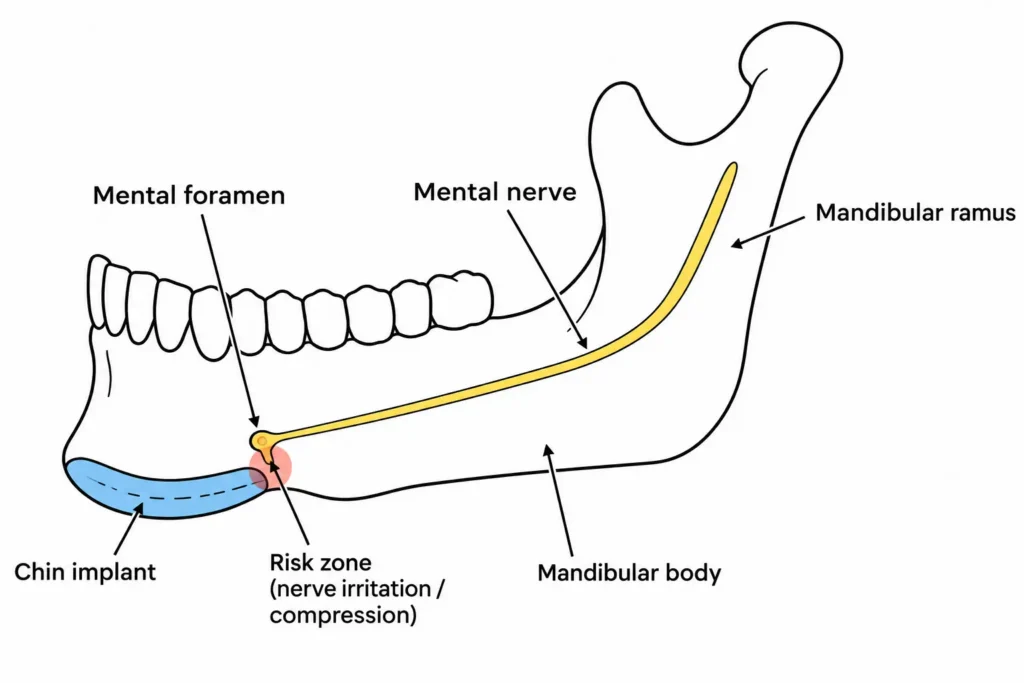
Numbness, tingling, or other changes in sensation can occur when surgery takes place near a sensory nerve. The exact risk depends on the implant location and surgical approach.
The 2025 systematic review reported nerve injuries in 2.1% of patients across the included facial implant literature. In a separate systematic review focused on alloplastic chin augmentation, reported paresthesia rates varied by implant material. Silicone had a reported rate of 0.4%, compared with 20.1% for high-density porous polyethylene and 3.2% for expanded polytetrafluoroethylene. [4]
These figures come from different groups of studies and should not be applied to every facial implant procedure. Chin, malar, and mandibular implants are placed in different anatomical areas, with different structures at risk.
Asymmetry
Implant asymmetry can occur when an implant does not sit exactly as planned or when the underlying facial skeleton is naturally asymmetric. Augmentation can make pre-existing differences more noticeable.
Asymmetry has been reported in studies of alloplastic chin augmentation and silicone facial implants. [3] [4]
In the systematic review of chin augmentation, asymmetry was one of the complications specifically evaluated alongside malposition, infection, extrusion, revision, and removal. [4]
Preoperative imaging can help identify asymmetry before surgery. Patient-specific implants have also been described as a way to plan three-dimensional correction when the mandibular anatomy is asymmetric. Mommaerts described CT-based planning and computer-aided manufacturing for patient-specific titanium jawline implants, including mirroring techniques to address differences between the two sides. [5]
Implant malposition and displacement
Implant malposition means that an implant is not in its intended position. It may be displaced, rotated, or positioned differently from the planned contour.
Malposition and displacement are established complications in the facial implant literature. [2] [3] [4]
In the systematic review of alloplastic chin augmentation, surgical approach was associated with differences in malposition, revision, and removal rates. Compared with subperiosteal placement, the dual-plane technique had higher reported rates of malposition, revision, and removal in the included studies. [4]
The position of the implant is also influenced by how it is stabilized. Published facial implant techniques include fixation with sutures or screws. [5] However, fixation should not be described as a guarantee against displacement. A 2023 review found no significant overall difference in complication rates between fixated and non-fixated silicone facial implants. [3]
Visible implant edges and prominence
Some patients can see or feel an implant after surgery. The literature describes this in terms such as palpability or prominence.
The frequency varies with implant material and anatomical site. Rojas et al. found more prominence problems with Medpor than with silicone in their review of published midface and lower-face cases. They also reported that prominence problems were more common with malar implants than with chin or mandibular implants. [2]
The available evidence does not provide one visibility rate that applies to every facial implant. Implant design, position, surrounding tissue, and the amount of augmentation can all affect the final contour. [6] [3]
Other possible complications
Facial implant complications include more than infection and displacement. Published reviews describe hematoma, persistent pain, wound problems, bone resorption or erosion, extrusion, and contour changes among reported complications.
The 2025 systematic review reported hematoma in 1.4% of patients, implant displacement in 0.59%, and bone resorption in 0.68% across the included literature. The authors also emphasized the heterogeneity of the evidence and the limited quality of some long-term data. [1]
Material can also influence the complication profile. Silicone, porous polyethylene, PEEK, titanium, and other materials have different physical and biological properties, and the available evidence does not establish one material as superior for every facial implant indication. [2]
Revision surgery
Not every complication requires a revision surgery. Some problems can be observed or treated without implant removal. Persistent infection, significant displacement, troublesome asymmetry, or dissatisfaction related to implant position may lead to facial implant revision. [4]
The type of revision depends on the problem. Possible approaches include implant removal, repositioning, fixation, replacement, or another corrective procedure.
In a study, among 98 patients who had received silicone chin implants, 24 were identified as having complications. The reported problems included displacement, bone resorption, and dissatisfaction. Revision procedures included implant removal followed by sliding genioplasty, orthognathic surgery, custom chin implant placement, and repositioning and fixation. [7]
This was a retrospective study of silicone chin implants, so its findings should not be generalized to every type of facial implant.
How careful planning can reduce risk
Careful planning cannot eliminate facial implant complications, but it can identify anatomical differences and help define the intended implant shape and position before surgery.
Three-dimensional imaging and computer-aided planning can be especially useful when there is facial asymmetry or when augmentation involves a more complex skeletal contour. Mommaerts described patient-specific titanium jawline implants based on preoperative imaging and provided technical recommendations for implant design, fixation, and surgical access. [5]
Complications were reported in 1.6% of patients treated with patient-specific implants compared with 6.5% of patients treated with off-the-shelf implants. However, the review noted substantial heterogeneity and stated that the added benefit of anatomical customization had not been systematically evaluated. [1]
These findings are therefore encouraging, but they do not prove that every patient has a lower complication risk with a custom implant.
The role of implant fixation
Implant fixation can be used to help maintain the position of a facial implant. Sutures and screws are among the fixation methods described in published studies.
The evidence is more nuanced than simply saying that fixation prevents complications. The 2023 review of silicone facial implants found no significant overall difference in complications between fixated and non-fixated implants.
Fixation is therefore one part of implant stabilization. Its use depends on the implant, anatomical site, surgical approach, and the individual surgical plan.
Surgeon experience and surgical technique
Surgical technique is one of the factors identified in the facial implant literature as contributing to complications. Cuzalina and Hlavacek’s review discusses improper selection or placement, neuropraxia, infection, migration, contour changes, palpability, postoperative asymmetry, and revision, along with their prevention and management. [8]
There are limited studies that quantify how the number of facial implant procedures performed by a surgeon changes complication rates specifically. Because of that, it would be too strong to assign a specific percentage reduction in risk to surgeon experience.
Relevant training and familiarity with facial implant surgery remain practical considerations when selecting a surgeon. The surgeon needs to understand the anatomy of the treatment area, choose an appropriate implant, position it correctly, and recognize complications when they occur. [5] [8]
The bottom Line
Facial implant complications include infection, impaired sensation, asymmetry, implant malposition, displacement, palpable edges, hematoma, bone changes, and revision surgery.
Risk varies by implant material, site, approach, and patient. Imaging and planning help define the target position, and fixation can stabilize selected implants. Custom planning has a role in complex anatomy, but the evidence doesn’t show it’s universally safer. Surgeon experience matters, though the literature doesn’t quantify how much it reduces risk.
Complications are possible even with careful planning. The practical question is how the implant, approach, and technique are being matched to the individual anatomy, and how risk is being managed at follow-up.
Frequently asked questions
What are the most common facial implant complications?
Published studies report infection, nerve injury or altered sensation, displacement, hematoma, asymmetry, and bone changes among the possible complications.
Can facial implants move after surgery?
Yes. Implant displacement or malposition has been reported, although the reported rate varies between studies and implant types.
Can facial implants cause numbness?
Yes. Temporary or persistent changes in sensation can occur when surgery is performed near sensory nerves.
Can facial implant complications require revision surgery?
Yes. Persistent infection, displacement, asymmetry, or other problems may lead to removal, repositioning, fixation, or replacement of the implant

References
- Kauke-Navarro M, Knoedler L, Baecher H, Sherwani K, Knoedler S, Allam O, et al. A systematic review of implant materials for facial reconstructive and aesthetic surgery. Front Surg. 2025;12:1548597. doi:10.3389/fsurg.2025.1548597.[↩][↩][↩][↩]
- Rojas YA, Sinnott C, Colasante C, Samas J, Reish RG. Facial implants: controversies and criticism. A comprehensive review of the current literature. Plast Reconstr Surg. 2018;142(4):991-999. doi:10.1097/PRS.0000000000004765.[↩][↩][↩][↩]
- Ahmed MG, AlHammad ZA, Al-Jandan B, Almohammadi T, Alam MK, Bagde H. Silicone facial implants, to fixate or not to fixate: a narrative review. Cureus. 2023;15(2). doi:10.7759/cureus.34524.[↩][↩][↩][↩][↩]
- Liao CD, Rodriguez E, Zhao K, Kunda N, George F. Complications following alloplastic chin augmentation: a systematic review of implant materials and surgical techniques. Ann Plast Surg. 2023;90(6S Suppl 5). doi:10.1097/SAP.0000000000003423.[↩][↩][↩][↩][↩][↩]
- Mommaerts MY. Guidelines for patient-specific jawline definition with titanium implants in esthetic, deformity, and malformation surgery. Ann Maxillofac Surg. 2016;6(2):287-291. doi:10.4103/2231-0746.200325.[↩][↩][↩][↩]
- Rojas YA, Sinnott C, Colasante C, Samas J, Reish RG. Facial implants: controversies and criticism. A comprehensive review of the current literature. Plast Reconstr Surg. 2018;142(4):991-999. doi:10.1097/PRS.0000000000004765.
[↩]
- Pokrowiecki R. Revision surgery after complications of silicone chin implants. J Clin Med. 2026;15(4):1326. doi:10.3390/jcm15041326.[↩]
- Cuzalina LA, Hlavacek MR. Complications of facial implants. Oral Maxillofac Surg Clin North Am. 2009;21(1):91-104. doi:10.1016/j.coms.2008.10.009.[↩][↩]