Moving beyond generic, flared overlays. The design network utilizes custom-milled PEEK mandibular matrices to structurally redefine the lower third from the gonial angle to the chin with high-precision anatomical mapping.
The flaws of standard lower-third augmentation
Traditional jaw augmentation frequently relies on off-the-shelf silicone wraps or standard pre-made angles. These generic components typically sit only on the lateral surface of the bone, which can create a wide, artificial volume that disrupts natural facial harmony. Furthermore, standard implants are highly limited in achieving vertical lengthening or correcting severe structural mandibular asymmetries. Due to a lack of precise anatomical seating, the continuous traction of the masseter muscles can lead to long-term implant migration, nerve compression, or localized cortical bone resorption.
The engineering blueprint: advanced gonial control
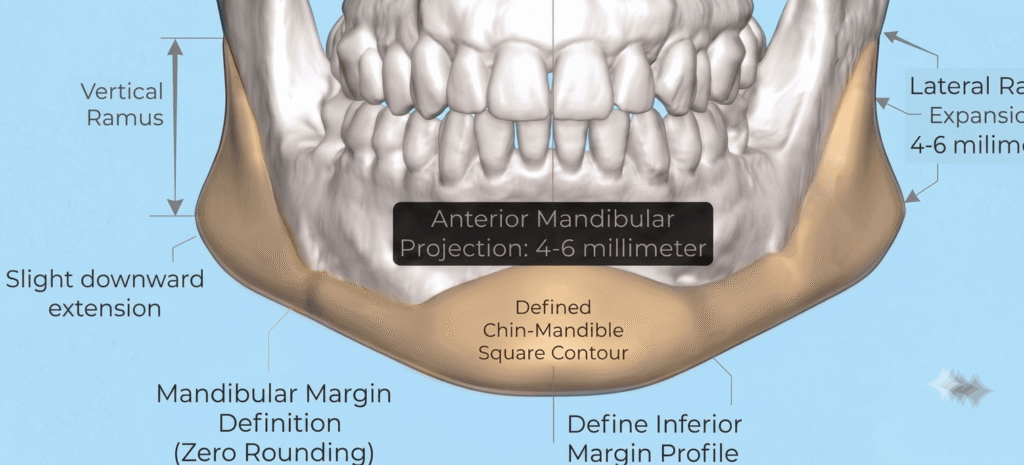
Custom PEEK jawline implants are digitally sculpted based on your unique DICOM CT data to establish a continuous skeletal framework. The 3D planning process allows for sub-millimeter modulation of the lower third.
Vertical and lateral expansion: Whether the objective is to optimize the bi-gonial width for a more defined lateral profile, or increase the vertical height of a steep mandibular angle, the digital design delivers precise geometric adjustments tailored to individual specifications.
Masseteric integration: The specialized micro-textured surface morphology of the implant is engineered to facilitate mechanical interlocking with adjacent soft tissues, supporting long-term stability and minimizing the risk of muscle shearing during mastication.
Feathered edge transitions: The margins of the PEEK matrix are engineered with ultra-tapered edges that blend smoothly into the natural ramus and body of the mandible, preventing palpable ridges or visible transitions.
Anatomical seating: Each customized gonial design incorporates an internal contours groove mapped directly to your natural jaw border. This architecture allows the independent network surgeon to position the implant with exceptional stability prior to securing the standard fixation screws, significantly minimizing the risk of post-operative rotation.
Symmetry optimization: Since natural craniofacial structures are inherently asymmetrical, the 3D design software compensates for bilateral bone variances by customizing the specific volume of each implant side, aiming for optimal visual balance and structural facial symmetry.
Custom PEEK chin architecture: precision sagittal and vertical projection. Advanced custom-engineered chin matrices designed to address structural recession, anatomical asymmetry, and mentalis strain without compromising soft-tissue harmony.
Why standard chin implants fall short
Standard pre-fabricated chin implants carry an inherent risk of instability. Due to an imperfect fit against the cortical bone, they frequently shift superiorly -causing unnatural soft-tissue bunching – or exert concentrated pressure inferiorly, leading to permanent underlying bone resorption over time.
The engineering blueprint: geometric mastery of the mentum
Advanced PEEK chin designs treat the symphysis menti not as an isolated component, but as the foundational anchor point of the entire lower-third silhouette.
Multidirectional projection: The 3D planning phase maps out the precise balance of sagittal projection (advancing a recessed profile) and vertical lengthening (elongating a short lower third) to ensure a balanced profile that respects natural soft-tissue dynamics.
Pre-jowl sulcus integration: Unlike standard chin components that can leave a hollow indentation between the chin and the jawline, custom-engineered matrices are designed to wrap smoothly across the mandibular body, establishing one continuous, uninterrupted contour.
Mentalis muscle protection: By ensuring an exact anatomical match to the underlying bony contours, the framework allows the operating network surgeon to place the implant with minimal disruption to the mentalis muscle complex, protecting post-operative lip competence and natural dynamic expression.
Skeletal modification beyond synthetic materials. For projects requiring intrinsic restructuring of the native bone, the platform facilitates direct connection with elite, board-certified maxillofacial surgeons specializing in complex lower-third osteotomies.
The power of native bone manipulation
While custom PEEK implants excel at adding volume and refined definition, certain structural anomalies – such as severe vertical deficiencies, functional malocclusions, or macrogenia – are best resolved by surgically repositioning the patient’s own skeletal framework. Independent maxillofacial experts within the network utilize advanced osteotomy techniques to structurally alter the mandibular foundation from within.
The engineering blueprint: precision surgical osteotomies
Every surgical bone cut and displacement is guided by comprehensive 3D digital simulation and custom surgical splints.
Sliding genioplasty: The independent maxillofacial specialist performs a controlled horizontal, vertical, or asymmetrical transection of the chin bone. This allows the native bone segment to be advanced, elongated, or shortened, securing permanent structural harmony without the use of extensive synthetic volume.
Custom chin-wing osteotomies: Unlike a standard isolated genioplasty, a comprehensive chin-wing osteotomy involves a continuous bone cut that extends from the symphysis back along the mandibular border. The network surgeon manipulates this continuous bone segment to alter both the width, projection, and vertical height of the anterior jawline simultaneously using the patient’s biological tissue.
3D-guided rigid fixation: All advanced osteotomies are planned digitally using specialized craniofacial software. The independent surgeon executes the planned displacement and permanently secures the bone segments using medical-grade titanium osteosynthesis plates and screws, ensuring absolute structural stability during the biological healing phase.
Hybrid skeletal orchestration: Patients can choose to combine 3D-guided osteotomies with custom PEEK overlays. Under this approach, the maxillofacial expert executes a sliding genioplasty or mandibular movement to optimize the biological foundation, followed by the seamless placement of custom-milled PEEK transitions to achieve high-definition, razor-sharp facial symmetry.