You saved up, picked a surgeon, and had your chin or jaw implant placed. The swelling went down. You look in the mirror and it’s not what you were told you’d look like. One side sits up higher than the other. The jaw line looks jagged, or the entire thing just looks bulky and slightly awkward. It’s a miserable place to be.
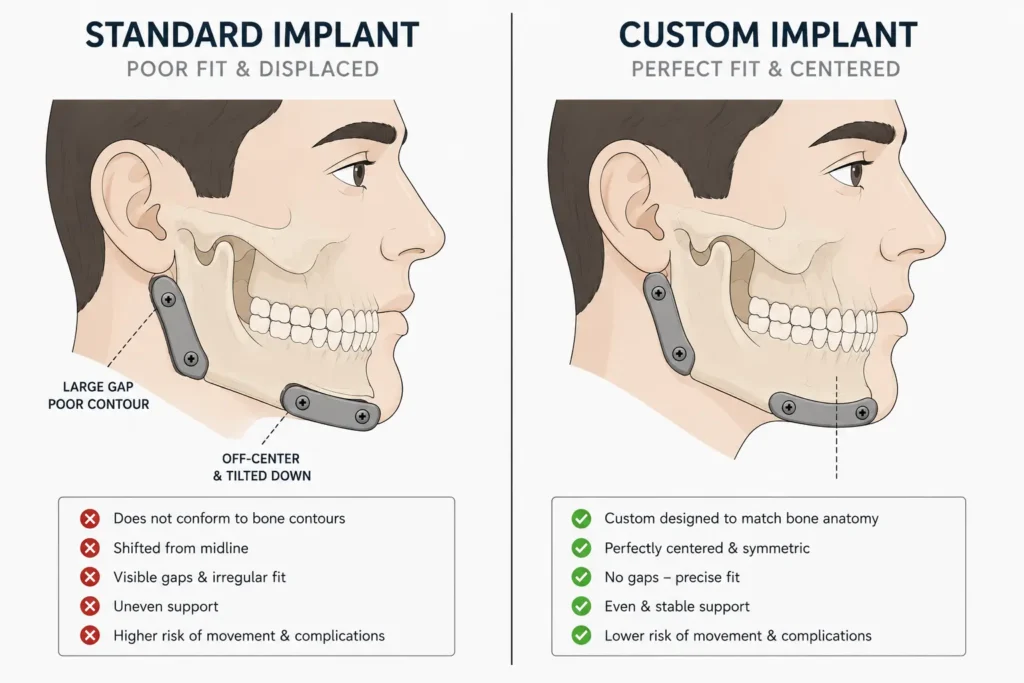
Here’s the part almost nobody tells you before going under that first knife. The problem isn’t always bad luck or a clumsy surgeon. The problem is usually the implant itself. A standard silicone implant is created as a symmetrical piece molded in standard sizes.
The human face it’s being implanted on is never symmetrical to begin with. That tiny flaw is why off-the-shelf implants so frequently end in aesthetic disappointment, and why facial implant revision surgery requires a custom design built at the level of the bone.
Key Takeaways
- Almost no face is truly symmetrical, so placing a perfectly symmetrical stock implant onto an uneven jaw tends to amplify the crookedness rather than hide it
- Standard silicone implants are linked to bone erosion underneath them and to displacement, two of the most common reasons a first result drifts into visible asymmetry
- A proper fix starts with mapping the exact errors, using photographs of the original face and a CBCT scan to measure where the old implant sits wrong and how much bone has been lost
- A custom implant is designed to your actual, asymmetric anatomy with different left and right dimensions, so it balances the underlying structure instead of masking the problem
Why a symmetrical implant makes an asymmetrical face worse
The face you started with was already uneven
Perfect symmetry in the face is nearly impossible. Using statistical shape analysis, researchers captured and measured 321 faces of young healthy adults. Bilateral left-right differences were found to be common, rather than rare, with one side of the face slightly dominating over the other [1]. This usually isn’t noticed as unattractive because to the human eye the differences are minute and our brains interpret them as symmetric. However, these differences exist in almost everyone.
Those differences also cluster in the lower face, which is exactly where chin and jaw implants go. In a survey of 1,460 patients at the University of North Carolina, 34 percent had clinically obvious facial asymmetry, and when it was present the chin was involved in 74 percent of cases, deviating to the left about 80 percent of the time [2]. The lower jaw is the most uneven part of the face for most people. It is also the part these implants are built to reshape.
A stock implant is perfectly symmetrical
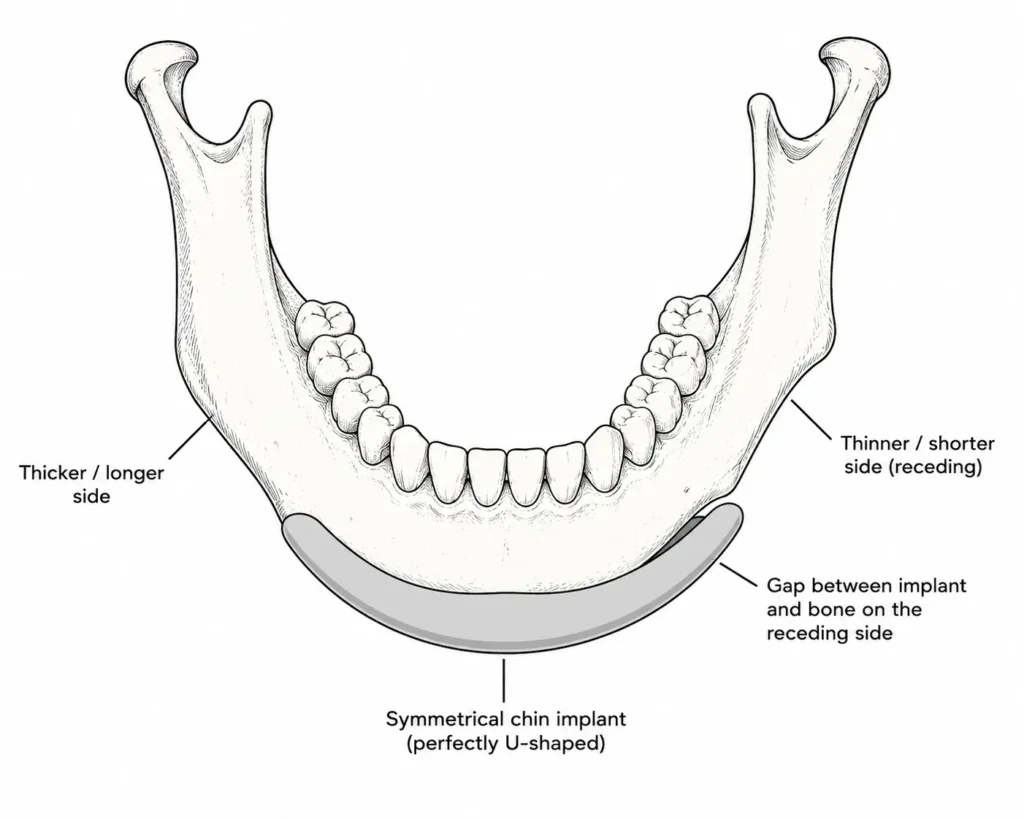
Now if you combine the two. An implant off the shelf is created in symmetric, mirrored sizes. Place that symmetric device onto an asymmetric jaw that is longer/naturally fuller on one side, you do not negate that asymmetry. You place a straight line on a diagonal line and the eye notices the difference immediately.
A recent study detailed this very scenario. One patient was left with hollowness at the lateral aspects of her chin after the implant only augmented her midline [3]. The implant didn’t mould to her face. Her face was moulded to the implant.
What actually goes wrong with off-the-shelf implants
The real issue with off-the-shield implants is the physical mismatch between them and the patient’s bone structure. Over time, this causes serious complications.
Bone erosion under the implant
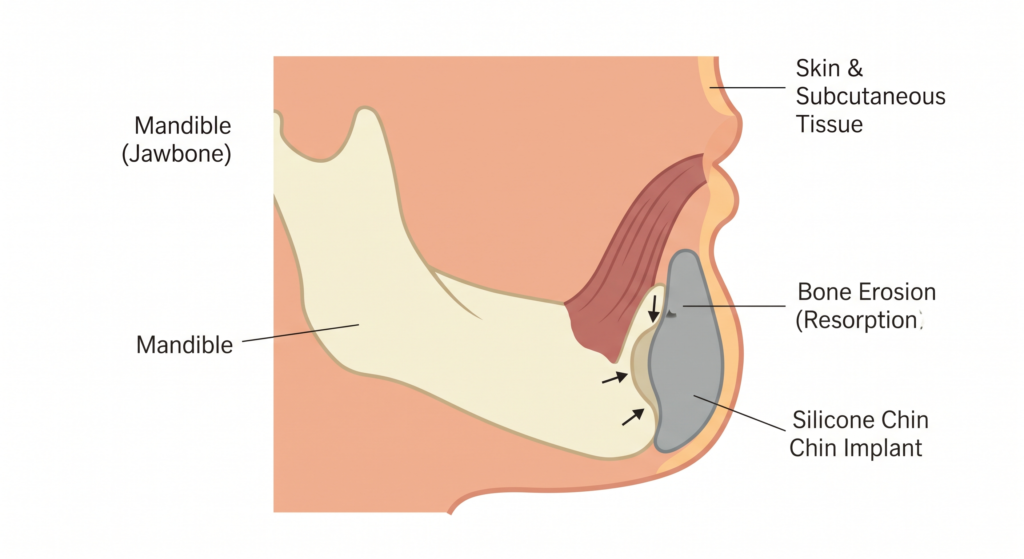
Silicone pressed against bone tends to sink into it over time. In a long-term study of silicone chin implants, 14 of 15 patients showed measurable bone erosion beneath the implant, up to 2.0 mm [4]. A narrative review found the problem was far worse when implants were left unstabilized, with bone resorption reported in more than 18 percent of non-fixated cases [5].
Some of that remodeling is silent and harmless. But when an implant is poorly seated, the pressure can carve into the jaw unevenly and pull the result off-center, and revision imaging routinely shows resorption running the length of a failed implant [3].
Displacement and poor fit
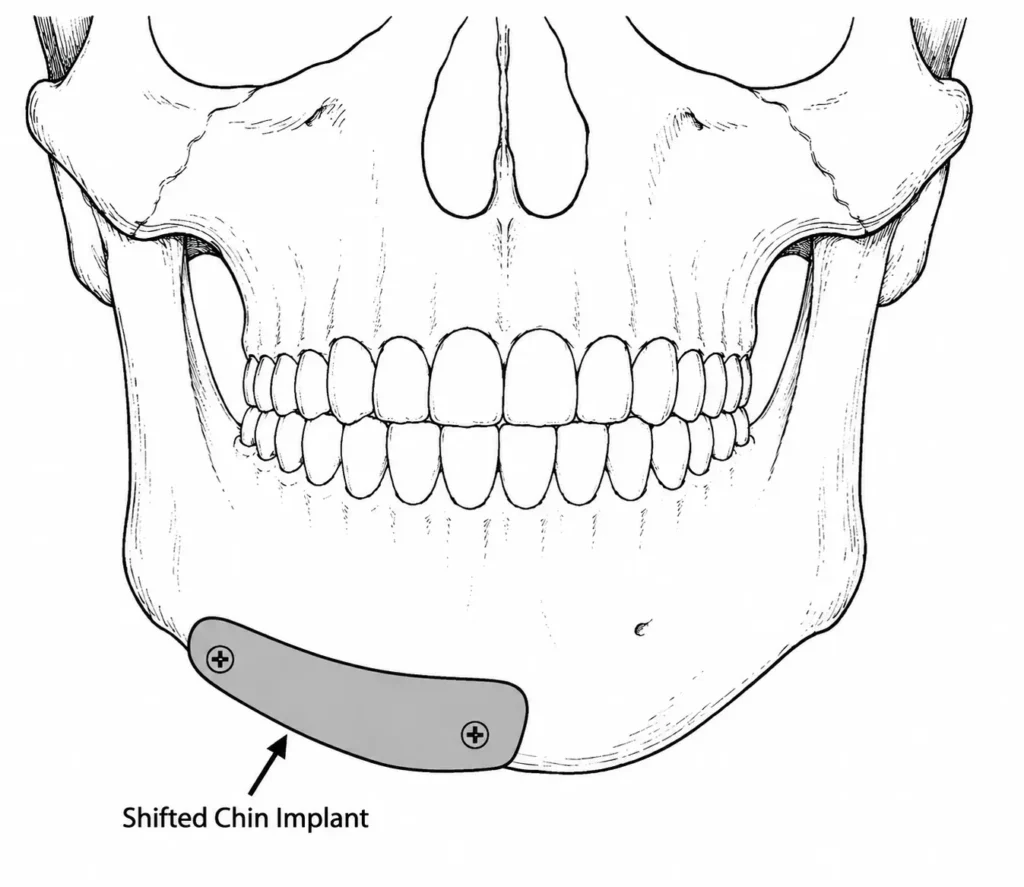
A standardised implant must also be jammed into a pocket that may not fit its shape, and this imperfect fit allows movement. The same review article includes displacement and asymmetry as in the expected complications of silicone facial implants [5].
In one revision case, a chin implant was implanted too high, over the point of the chin rather than over the lower border, and it slid down into a groove giving almost no projection where the patient wanted it [3].
An implant that migrates even a few millimetres from its intended position turns a symmetrical object into an asymmetrical result.
The result is a face that looks off, and a patient who knows it
Put erosion and displacement together and you get the outcome that brings people in for revision.
Among 24 patients with silicone chin implant complications in a study, the reasons for facial implant revision surgery broke down into displacement, bone resorption, both at once, and plain dissatisfaction with the look [3]. None of these are exotic. They are the predictable failure modes of trying to fix one specific face with a generic part.
Can custom implants go wrong too?
One clarification is worth making, because the picture has shifted over the years. Off-the-shelf implants were the norm a couple of decades ago, and a good deal of the asymmetry surgeons revise today dates from that era. Most implants placed now are custom. But custom describes how an implant is made, not whether it was designed well, and a poorly planned custom implant can leave a face just as crooked as a stock one.
A custom implant is only as good as the scan and the plan behind it. Accuracy is not absolute. Even in a series of patient-specific implants designed for asymmetry, a minority of cases still fell outside the intended target once placed [6].
The design can also aim at the wrong thing. If it mirrors the wrong side of the face or ignores how soft tissue will drape over the new shape, it can bake a fresh asymmetry into a part that then fits the bone perfectly. Research on skeletally driven planning found it can leave undesirable aesthetics and residual asymmetry, because a symmetric skeleton does not reliably produce a symmetric face [7]. A sound design placed a few millimetres off during surgery does the same.
So the answer to a bad result is not simply “get a custom implant.” It is a disciplined design and placement process, which is what the revision roadmap below is really about.
The revision roadmap: from mapping the errors to a custom fix
Revision is not simply swapping in a bigger implant. Done properly, it is a measured rebuild, and facial implant revision surgery at this level follows a clear sequence.
Step 1: Map the existing errors
Revision planning begins with facts, not assumptions. Pictures of your original anatomy and your current outcome reveal what moved and where asymmetry now registers most. A CBCT scan provides three-dimensional maps that quantify where the old implant is sitting, how much it has shifted, and how much underlying bone you’ve lost.
Revision surgeons rely on precisely this information to visualize resorption and malposition that cannot be detected by outward appearance alone [3].
Step 2: Design a custom implant to your real anatomy
This is where a custom implant parts ways with a stock one. Instead of picking from a tray of symmetrical sizes, the implant is designed from your own scan, with different left and right dimensions built to match your specific bone.
A study of patient-specific implants used for facial asymmetry found that planned and actual positions landed within roughly half a millimetre to a millimetre of target, with most of the corrected surface inside a 2 mm accuracy threshold [8].
The goal is not to paste volume over the problem. It is to balance the underlying structure, building up the deficient side more than the fuller one so the two halves finally read as a pair.
Step 3: Remove the old implant and place the custom one
With the plan set, the failed implant comes out and the custom piece goes in, fixed to the bone so it cannot drift. Modern revision protocols do exactly this, removing the stock silicone and replacing it with a custom jaw implant or chin implant designed for the individual [3]. Because the new implant is built to seat on one specific footprint, it has far less freedom to displace, which was half of the original problem.
What a custom approach can and cannot fix
Honesty is important here, because a custom implant isn’t magic. It works best when the asymmetry has to do with contour and volume rather than structure. That is, one side of your jaw, angle, or chin was underbuilt.
One thing it can’t do is fix problems caused by the bite, tilted jaw, or jaw joint position. Those relate to the skeleton itself, and require an osteotomy vs. implant [8].
Even the soft tissue can hang back from your new structure. Sometimes a minor revision helps the skin/fat lie smoothly over everything. Your surgeon will tell you if you’re in that category before making promises.
The bottom line
An asymmetrical face was never going to be balanced by a symmetrical, mass-produced part. That mismatch, together with the bone erosion and drift that stock silicone invites, is why so many first results end in disappointment.
The way out is not a bigger version of the same thing. It is a plan built from your own photographs and scan, and a custom implant shaped to the face you actually have. If you are living with a result that looks off after a previous implant, a revision assessment can map what went wrong and what it would take to correct the facial asymmetry.
Frequently asked questions
Can a custom implant really fix asymmetry left by an old chin or jaw implant?
In most contour-and-volume cases, yes. Because a custom implant is designed from your own scan with different left and right dimensions, it can add more to the underbuilt side and balance the two halves in a way a symmetrical stock implant cannot. It works best when the issue is the shape of the implant rather than the position of your jaw or bite.
Do off-the-shelf silicone implants really cause bone erosion?
Often, to some degree. One long-term study found measurable erosion under the implant in 14 of 15 chin cases, and resorption is far more common when an implant is not fixed in place. Much of it is minor and causes no symptoms, but uneven erosion under a poorly seated implant can pull the result off-center and is a common finding at revision.
Will removing my old implant leave damage behind?
Some bone remodeling under an old implant is expected, and a CBCT scan taken beforehand shows exactly how much. That map becomes part of the plan. The custom replacement is then designed around the current state of the bone rather than the bone you had before the first surgery, which is one reason the imaging is done first instead of assessed on the day of surgery.
How is a custom implant designed for my face?
It starts with a CBCT scan of your jaw, which becomes a 3D model of your real anatomy. The jaw implant is designed on that model to fit one specific footprint and to correct your specific imbalance, then manufactured to those exact measurements before surgery. Nothing is chosen from a standard size range.
References
- Ercan I, Ozdemir ST, Etoz A, Sigirli D, Tubbs RS, Loukas M, Guney I. Facial asymmetry in young healthy subjects evaluated by statistical shape analysis. J Anat. 2008;213(6):663-669.[↩]
- Severt TR, Proffit WR. The prevalence of facial asymmetry in the dentofacial deformities population at the University of North Carolina. Int J Adult Orthodon Orthognath Surg. 1997;12(3):171-176.[↩]
- Pokrowiecki R. Revision surgery after complications of silicone chin implants. J Clin Med. 2026;15(4):1326.[↩][↩][↩][↩][↩][↩]
- Sciaraffia CE, Ahumada MF, Parada FJ, Gonzalez E, Prado A. Bone resorption after use of silicone chin implants, long-term follow-up study with lateral chin radiography. Plast Reconstr Surg Glob Open. 2018;6(7):e1850.[↩]
- Gafar Ahmed M, AlHammad ZA, Al-Jandan B, Almohammadi T, Khursheed Alam M, Bagde H. Silicone facial implants, to fixate or not to fixate: a narrative review. Cureus. 2023;15(2):e34524.[↩][↩]
- Buchholzer S, Moissenet F, Aymon R, Scolozzi P. Refining orthognathic outcomes: 3D accuracy with patient-specific implants for facial asymmetry correction. JPRAS Open. 2025;45:95-108.
[↩] - Lee J, Kim D, Xu X, Kuang T, Gateno J, Yan P. Predicting optimal patient-specific postoperative facial landmarks for patients with craniomaxillofacial deformities. Int J Oral Maxillofac Surg. 2024;53(11):934-941.
[↩] - Buchholzer S, Moissenet F, Aymon R, Scolozzi P. Refining orthognathic outcomes: 3D accuracy with patient-specific implants for facial asymmetry correction. JPRAS Open. 2025;45:95-108.[↩][↩]