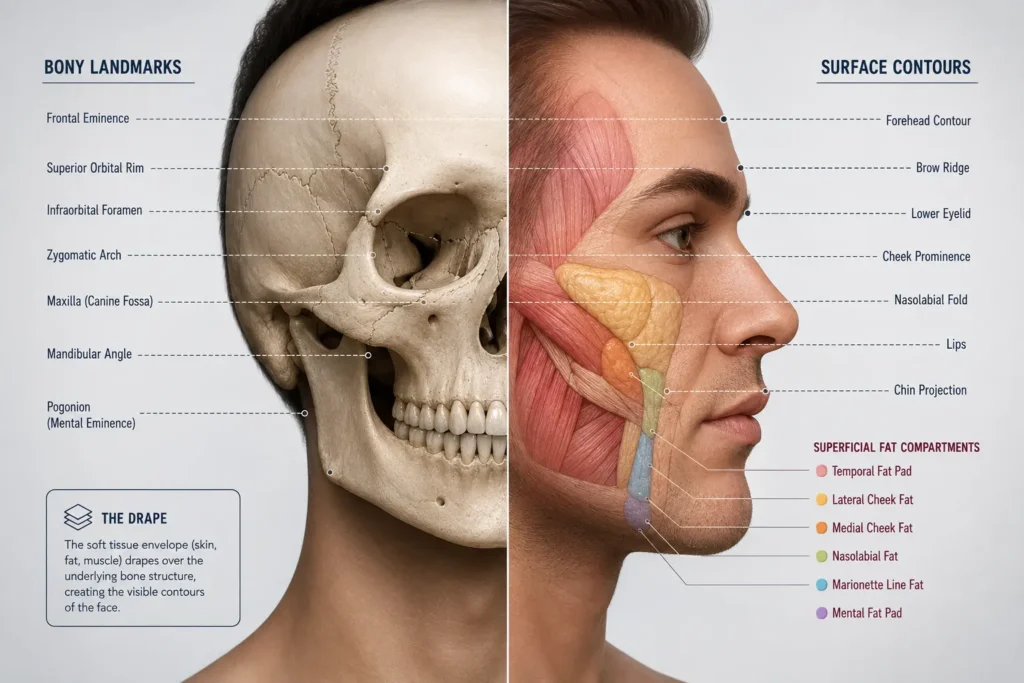
When you look at a jaw on a CT scan, you will see a sharp angle, a strong chin, and clean definition. Then look at the real face sitting over that same bone, and you never see the skull. You see skin, fat, and muscle lying across it, and that outer layer is what decides how the face reads. This is the part that a lot of surgical planning gets wrong, and it is the whole difference between a result that looks like you and one that looks unnatural.
The question sits at the meeting point of bone structure vs soft tissue. Bone sets the platform. The tissue draped over it turns that platform into a face. If you change one side of that equation without accounting for the other, the results will be poor.
Key Takeaways
- With 3D simulation, we can now predict how soft tissue will drape to within a few millimeters across most of the face. We use that information
- Bone provides the framework of the face and is by far the most important determinant of facial shape, yet it is the soft tissue laid over top of the bone that determines the outcome that people see
- When bone is moved with an implant or osteotomy, the skin and fat that overlies it must drape over that new shape. Because this process is asymmetrical, the skin and fat won’t lie perfectly smooth until swelling resolves over months
- Planning solely to the skull can lead to over-restored bulk or excessive sharpness, as a thick or thin soft tissue envelope alters the appearance of even the same bone
Why the bare skull is only half the equation
A facial skeleton is a frame. It projects, it angles, it gives width. The frame is not the finished object, though, and treating it as if it were is where trouble starts. Facial soft tissue depends on the hard tissue underneath it, yet the two do not track each other perfectly.
In a geometric morphometric study of 86 lateral head cephalograms, the shape of the soft tissue did not follow the underlying bone as closely as the researchers expected, and the midface in particular showed weak covariation between the two [1]. So the skull predicts a great deal, but it does not predict everything.
That gap becomes the whole story the moment someone plans to move bone.
What the facial skeleton sets
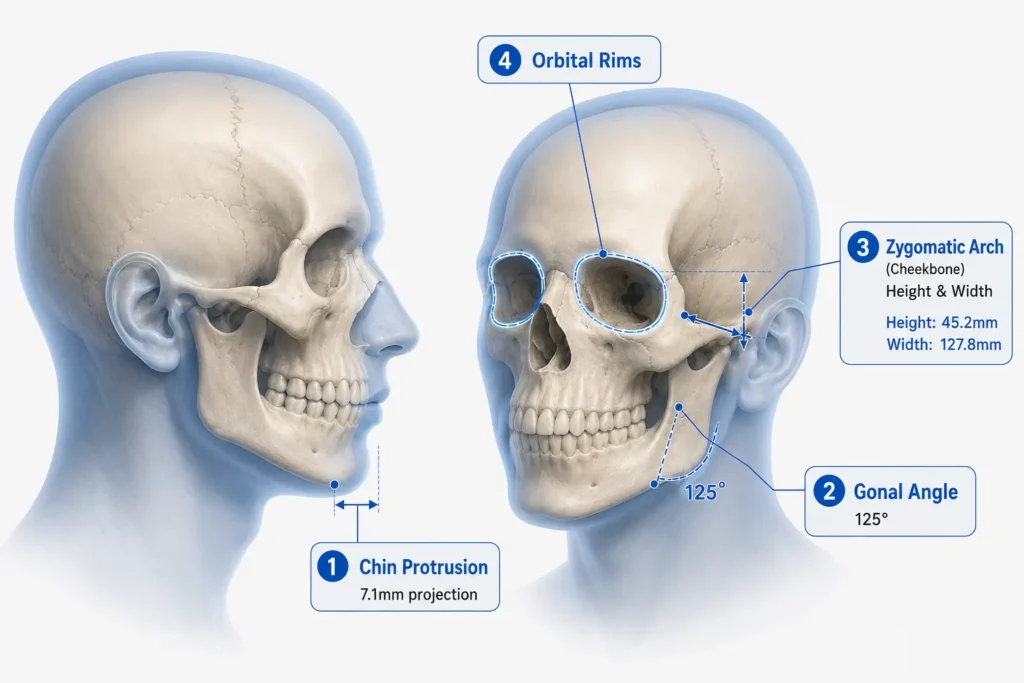
The skeleton determines a few key traits you can’t sculpt with skin:
- How much the chin protrudes
- The angle where the lower jaw corners meet (gonial angle)
- The height of the cheekbones and the width of the cheekbones at the zygomatic arches
- The bones that outline the eyes (orbital rims)
Move any one of these with surgery, and you move the scaffolding the rest of the face hangs on, which is why orthognathic surgery and bone grinding produce results that injectable fillers and creams can’t.
The layer that sits on top
The facial soft tissue envelope sits on that scaffolding: muscle, fat compartments, and skin. Each of those layers is a different thickness in different areas of the face, and each varies from patient to patient. This is where the soft tissue thickness influences the results.
Researchers pooled 34 implant dentistry studies with more than 1,500 patients. They found that thicker tissue around an implant correlated with better aesthetic outcomes, more papilla presence and thickness, and less recession than surrounding sites with thin tissue. Sites with thin tissue showed approximately 0.62 mm more recession on average [2]. Patient satisfaction also favoured thicker tissue in that review.
Thin soft tissue simply doesn’t obscure the underlying bone. It’s like shrink wrap. Thick tissue, on the other hand, smooths out that same anatomy. Not one or the other is objectively better. The surgeon needs to know what they’re dealing with going into the case.
How much does bone structure determine your face?
Here is the honest answer to whether bone structure determines your face. It sets the scaffold, and the scaffold is the strongest single factor in play. It does not lock the outcome.
Two people with near-identical jaws can read very differently once you account for how fat sits and how thick the skin is, and the same person can look heavier one year and sharper the next from tissue change alone. Bone is the strongest factor. It is not the only one, and pretending otherwise is how planning goes wrong. Which is exactly why moving bone is a bet, not a certainty.
What happens to soft tissue when you change the bone?
There are two ways to change the foundation. You can add to it, or you can cut it and move it.
Implants versus bone cutting
Adding volume usually means a custom jaw implant, a chin implant, or a cheek implant. A custom jaw implant is designed from a 3D CT scan so that it fits one specific face, then fixed to the bone with small titanium screws during a procedure that runs around two hours, with the surgeon moving tissue and fat aside to seat it.
The other route is an osteotomy. The surgeon cuts the bone itself and repositions it, as in a sliding genioplasty or a bimaxillary operation. One route slides a new layer of volume under the tissue. The other relocates the tissue’s own foundation. They feel different on the surface for exactly that reason.
In fact, neither one occurs without the other. Altering the jaw also changes the relationship between the chin, cheeks, and neck. Therefore, surgeons often perform an implant or osteotomy along with another procedure to ensure that the entire face advances at the same rate, rather than one region being more protrusive than the others. A prominent jawline with a recessed chin that was left untouched can look even more unnatural than before starting treatment.
The drape
Either way, the tissue has to react. The soft tissue drape is how skin and fat redistribute over the new contour once the bone underneath has moved. Skin sitting directly over the moved segment shifts the most. Skin toward the edges barely moves, so the transition zones behave differently from the centre and can betray a poorly planned change.
None of this happens on the operating table. Swelling can take several months to settle, and until it does, the true shape stays hidden under fluid. A patient judging the result at two weeks is actually judging swelling, not the face they will keep.
Why can the result look bulky or wrong?
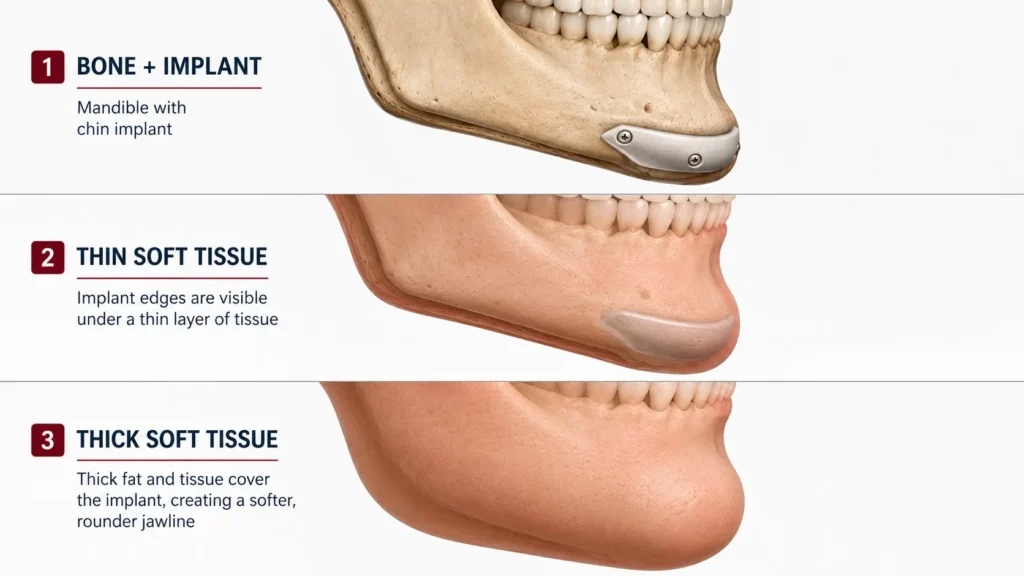
Surgery can look unnatural when the planning is thin. Design purely to the skull, ignore how thick the covering is, and a heavy envelope can turn a crisp, planned angle into something wide and blocky.
Thin tissue actually does the opposite. It exposes every margin and step-off, so an implant that looked conservative on the model can translate as aggressive or bony in the real thing. The bone can be beautifully designed, and the face can still fall flat, because, as we said earlier, the bone plan only addressed half of the equation.
Predicting the drape before surgery
The way out is to model the tissue, not the bone alone, before anyone operates. That is the job of modern 3D soft tissue simulation.
Flat tracings vs 3D virtual planning
Older planning leaned on 2D tracings and rough ratios for how far the lip follows the chin. Virtual surgical planning replaced that with 3D models built from CBCT scans and surface photographs, then added software that predicts how the face will drape over the planned bone moves. Orthognathic soft tissue prediction is now a routine step in maxillofacial units rather than a research novelty.
How accurate is it?
The 3D soft tissue simulation is accurate enough to trust, but it has real blind spots.
In a 2025 study of 60 class III patients after double-jaw surgery, predictions using Simplant O&O software hit a mean error under 2.0 mm overall. Clinically acceptable. The chin was the least predictable region at about 1.5 to 1.6 mm of error, and cheek and lower-lip movements were often underestimated [3].
An independent 2025 deep-learning model trained on 458 patients processed images from 3D photographs only and generated an entire facial prediction in approximately 0.02 seconds. Average accuracy was 1.17 mm, with the best accuracy around the nose at 0.55 mm and the lowest accuracy around the chin at 1.60 mm. There was no radiation used [4].
A third platform, IPS CaseDesigner®, correctly predicted between 69 and 96 percent of the facial surface, depending on the region. The upper face came out easier than the lower lip and chin [5]. Look at that range. A strong system can nail most of the face and still land well off on the exact zone people care about most.
The pattern across all three is the same. Lips and chin are the hardest zones to predict in almost every study because that tissue is mobile, muscular, and varies a lot between people. A surgeon who tells you the simulation is exact everywhere is overselling it. A careful one shows you the model and says plainly where it’s least sure.
Planning from the face backward
The sharper move is to flip the order entirely. Traditional planning is skeletal-driven, meaning you fix the bone and trust that the face will follow.
Research on that approach found it can leave undesirable aesthetics and residual asymmetry behind, because a symmetric skeleton does not reliably produce a symmetric face [6]. Soft-tissue-driven planning starts from the target appearance and works backward to the bone movements that would create it. You design the outside first, then solve for the inside that gets you there.
The bottom line
Bone determines the framework. What we see in a face, though, is shaped by every millimetre of fat, muscle, and skin overlaying that framework, and those layers don’t shift uniformly. That’s why planning based solely on the skull can lead to outcomes that are too bulky, too peaked, or just unnatural.
The better approach starts from the face you want and works backward to the bone changes that would produce it. Today, we can do that using 3D simulation, with positional accuracy better than 2 millimetres across most of the face. However, the lower third remains least predictable in every study we’ve discussed above. This means that the results can’t be 100% guaranteed..
A reputable surgeon will show you the simulated model and point out where the real-life result is most likely to vary. If you’re considering facial bone surgery and want a plan that accounts for both layers, not just the skeleton, contact us today.
Frequently asked questions
Does bone structure or soft tissue matter more for how your face looks?
Bone matters more because it sets the scaffold that everything else sits on. But soft tissue doesn’t just follow the bone. It varies in thickness, which changes how the same skeleton reads from the outside. So, they are basically two layers of one system.
Can a 3D simulation really show what my face will look like after jaw surgery?
For most of the face, yes. Studies put predictions within one to two millimetres of the real outcome, and newer deep-learning tools can generate a preview in a fraction of a second from photos alone. The lips and chin are still the least accurate zones, so treat any simulation as a strong planning tool, not a guarantee.
Why do some jaw or chin implants look unnatural?
Usually, because the plan was built around bare bones without accounting for tissue thickness. Thick tissue turns a clean angle bulky. Thin tissue shows every edge. Oversizing the implant and skipping the simulation make things worse.
References
- Malá PZ, Krajíček V, Velemínská J. How tight is the relationship between the skeletal and soft-tissue facial profile: a geometric morphometric analysis of the facial outline. Forensic Sci Int. 2018;292:212-223.[↩]
- Bienz SP, Pirc M, Papageorgiou SN, Jung RE, Thoma DS. The influence of thin as compared to thick peri-implant soft tissues on aesthetic outcomes: a systematic review and meta-analysis. Clin Oral Implants Res. 2022;33(Suppl 23):56-71.[↩]
- Chen CYH, Xi T, Ko EWC, Tsao SY. Accuracy of 3D simulation in soft tissue change after orthognathic surgery in class III malocclusion: influence of different vertical facial patterns. J Craniomaxillofac Surg. 2025;53(12):2133-2141.[↩]
- Berends B, Bielevelt F, Baan F, Schreurs R, Maal T, Xi T, de Jong G. Soft-tissue prediction based on 3D photographs for virtual surgery planning of orthognathic surgery. Comput Biol Med. 2025;194:110529.[↩]
- Awad D, Reinert S, Kluba S. Accuracy of three-dimensional soft-tissue prediction considering the facial aesthetic units using a virtual planning system in orthognathic surgery. J Pers Med. 2022;12(9):1379.[↩]
- Lee J, Kim D, Xu X, Kuang T, Gateno J, Yan P. Predicting optimal patient-specific postoperative facial landmarks for patients with craniomaxillofacial deformities. Int J Oral Maxillofac Surg. 2024;53(11):934-941.[↩]