
A wrap around jaw implant is a design that addresses a broad portion of the lower jaw within one coordinated treatment plan. Instead of treating the chin, mandibular body, and jaw angles as completely separate areas, the design follows the mandibular contour and plans the connected regions together. The concept dates back to the mandibular matrix implant system, while recent patient-specific research has examined PEEK implants designed for mandibular wrap-around augmentation. [1] [2]
The main reason to consider this approach is coordination. When the planned correction extends across several connected parts of the jaw, the surgeon can design those regions together rather than treating each one independently. Patient-specific implant planning allows the intended contour to be developed from the patient’s own anatomy. [1] [2] [3]
Key takeaways
- Wrap around jaw implants can address connected areas of the mandible, potentially including the chin, mandibular body, and jaw angles within one planned design.
- A wrap-around approach may be considered when several adjacent regions require augmentation and their transitions are part of the desired contour.
- Separate implants can still be appropriate when the problem is limited to a particular region, such as isolated chin or mandibular angle deficiency.
- Current research does not establish wrap-around implants as universally superior to separate implants. The specific evidence comparing these approaches for aesthetic jaw augmentation remains limited.
What is a wrap-around jaw implant?
A connected approach to lower-jaw augmentation
The term mandibular wrap-around implant describes an implant design that extends around a substantial portion of the mandibular contour. The original mandibular matrix implant system included an articulated wrap-around geniomandibular implant together with wrap-around gonial angle components. A prejowl component could also be added or used instead of the chin component. [1]
The system was made from high-density porous polyethylene, not PEEK. It was developed to restore mandibular volume and was used in patients with a congenitally small mandible, edentulous patients, and selected patients requesting facial enhancement. The published system involved multiple connected components rather than necessarily being one solid piece. [1]
Modern patient-specific planning has extended this general concept to digitally designed implants. A 2026 proof-of-concept study evaluated patient-specific PEEK implants for mandibular augmentation, including three cases with a mandibular wrap-around implant and one case with implants limited to the gonial regions. [2]
What areas can it augment?
A wrap-around design can extend from the chin along the mandibular body toward the jaw angles. The exact extent depends on the anatomy and the planned correction. The original mandibular matrix system was specifically designed to address the chin and mandibular angle regions as connected parts of the lower facial skeleton. [1]
Patient-specific planning can also allow different dimensions to be incorporated into different parts of the implant. For example, the 2026 PEEK study measured implant thickness at both the Pogonion region of the chin and the Gonion regions at the mandibular angles. [2]
When can a wrap-around design make sense?
When the chin and jawline both need correction
Some patients are concerned about more than chin projection alone. They may also want augmentation along the mandibular body or greater definition at the jaw angles. When several of these areas require correction, a coordinated design can address them as part of the same mandibular contour. [1] [2]
The mandibular matrix system was developed to restore volume across the lower face rather than focusing on a single isolated point. More recent patient-specific PEEK work has similarly examined implants extending across the mandibular jaw-chin region. [1] [2]
When transitions along the jawline matter
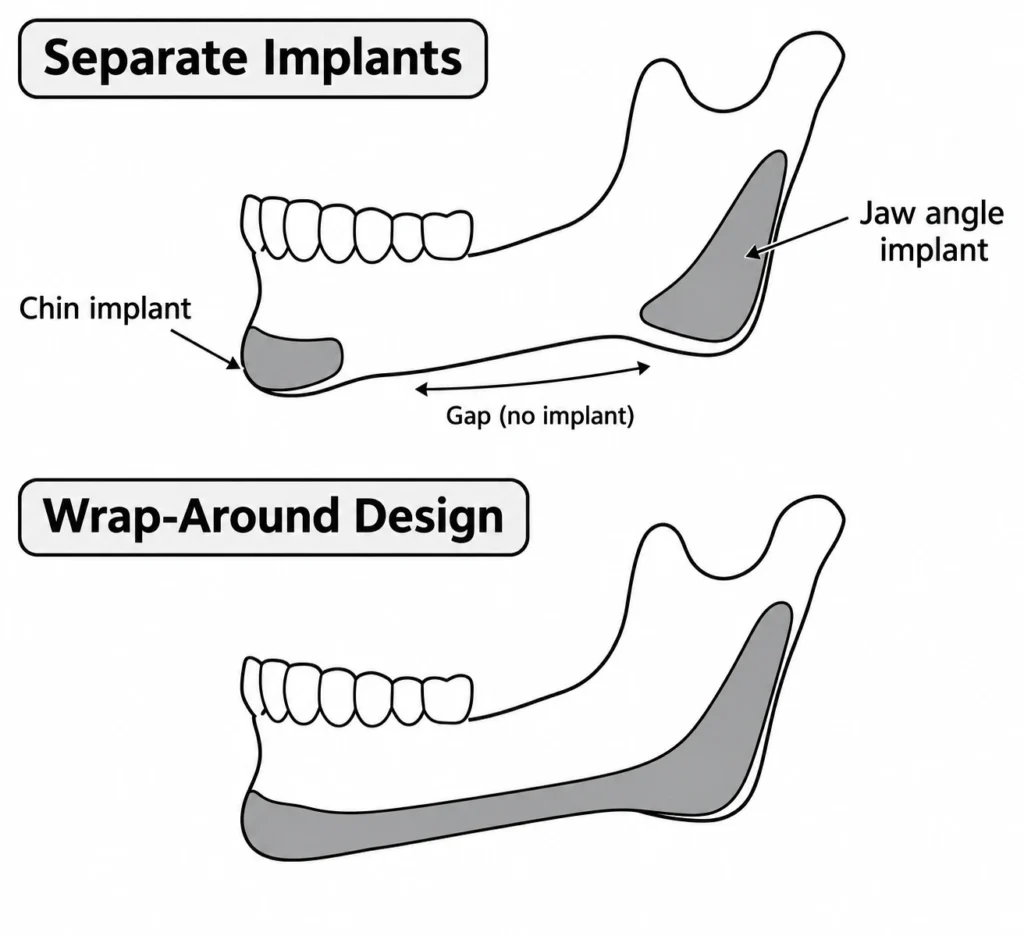
The mandibular contour continues from the chin through the body of the mandible to the angle. A patient-specific design allows these regions to be considered together when planning the desired contour. Patient-specific jawline implants have been described using three-dimensional computer-aided design and manufacturing, including designs extending along the mandibular border. [3] [4]
Wrap-around implants vs separate implants
Separate implants can work for localized problems
A full wrap-around design is not automatically necessary. When the anatomical problem is limited to one region, localized augmentation may be sufficient. For example, mandibular angle augmentation can be performed using an angle implant, including patient-specific PEEK implants. [4] [3]
The appropriate approach therefore depends on what needs to be changed. A broader design may be considered when several connected regions require augmentation, while a more localized implant may be suitable when the deficiency is confined to one area.
A wrap-around approach plans connected regions together
With separate implants, each component is designed and positioned independently. A wrap-around concept instead considers a larger portion of the mandibular contour as one geometric plan. The classic mandibular matrix system used overlapping components, while modern patient-specific planning can determine implant geometry from the patient’s anatomy. [1] [2] [3]
Three-dimensional planning may also account for asymmetry. The original mandibular matrix paper reported use of an additional prejowl component to address asymmetry, while patient-specific jawline literature describes the use of three-dimensional planning for asymmetric and deformational cases. [1] [3]
This should not be presented as proof that a wrap-around implant produces better aesthetic results than separate implants. The available literature does not provide strong direct comparative evidence for that specific question. More broadly, a 2025 systematic review found that the clinical benefits of patient-specific customization have not yet been systematically established across facial implant surgery. [5] [6]
How custom planning changes the process
CT and CBCT provide three-dimensional anatomy
Patient-specific implant planning begins with three-dimensional imaging. The 2016 patient-specific jawline study describes design from segmented CT data, while the 2026 PEEK study used preoperative and postoperative CBCT scans to evaluate mandibular augmentation. [2] [3]
This allows the implant geometry to be planned against the actual mandibular anatomy rather than relying only on standard dimensions.
The proposed contour can be assessed before surgery
Computer-aided planning allows the proposed implant to be designed and reviewed before fabrication. Patient-specific jawline work has used computer-generated designs and preoperative renderings, while the recent PEEK study incorporated the designed implant into a computational model of the expected soft-tissue changes. [2] [3]
The 2026 study included only four patients and was explicitly designed as a proof of concept. Three patients had mandibular wrap-around PEEK implants. The authors concluded that the prediction method requires confirmation in larger cohorts before clinical implementation. [2]
Digital planning can therefore help with implant design and visualization, but it cannot guarantee the exact final appearance.
When separate implants may be more appropriate
When only one part of the jaw needs augmentation
A patient with isolated chin deficiency may not need augmentation across the entire mandible. The same applies when the primary concern is limited to the posterior jaw angles. Patient-specific and conventional implants can be used for localized mandibular contour correction. [3] [4]
When the underlying problem is skeletal position
Implants add volume to the existing skeleton. They do not reposition the mandible in the way orthognathic surgery does. Patient-specific facial implants can also be used alongside orthognathic procedures when additional contour augmentation is needed, but the underlying skeletal problem still has to be assessed separately. [5] [6]
Is a wrap-around jaw implant always one piece?
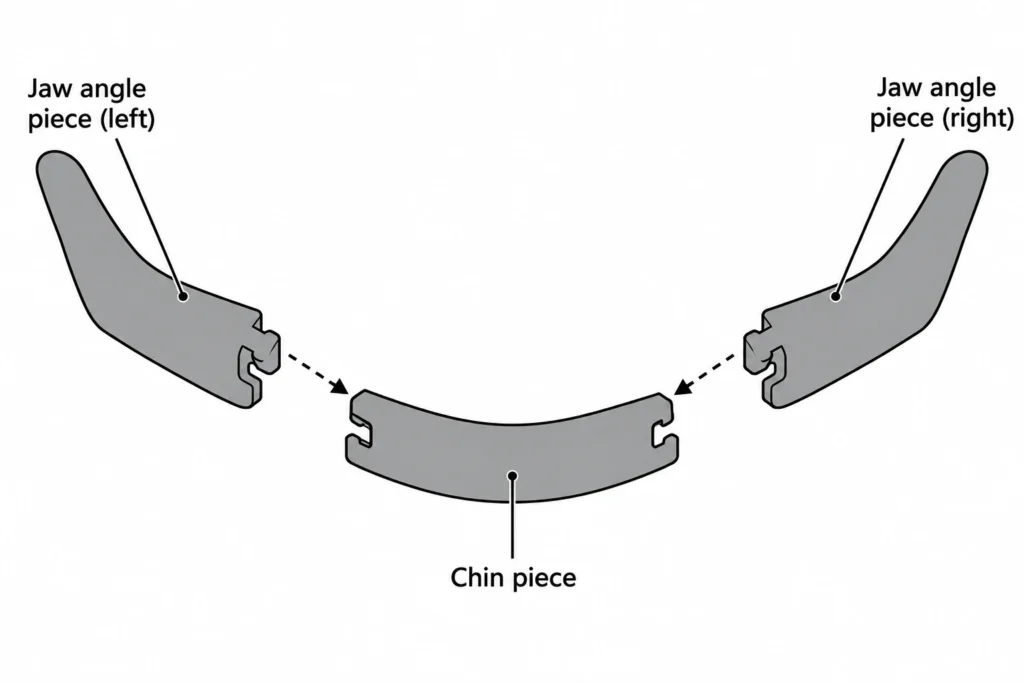
Not necessarily. The classic mandibular matrix system was made from several interacting components. It included an articulated geniomandibular component and separate gonial angle components that overlapped to create a coordinated mandibular augmentation. [1]
Patient-specific implants can also be divided into multiple segments when anatomy or surgical access makes this necessary. Mommaerts described splitting a patient-specific jawline implant into two parts and reconnecting the segments with a three-dimensional puzzle connection when needed. [3]
What makes a design “wrap-around” is therefore the extent and coordination of the augmentation, not necessarily whether the final implant is manufactured as one physical piece.
The bottom line
Wrap around jaw implants provide a way to plan chin, mandibular body, and jaw-angle augmentation as a coordinated lower-jaw contour. The concept has been described for decades, beginning with the mandibular matrix implant system, and patient-specific PEEK wrap-around implants have now been evaluated in a small 2026 clinical proof-of-concept study. [1] [2]
A wrap-around design may be considered when several connected regions need augmentation and the transitions between them are part of the planned contour. It is not automatically better than separate implants, and there is not yet strong direct evidence establishing one approach as superior. [5] [6]
Facial Nexus can coordinate your connection with an independent implant designer and qualified surgeon, who can assess the anatomy, imaging, treatment goals, and whether a wrap-around or separate implant approach is appropriate.
Frequently asked questions
What is a wrap-around jaw implant?
It is a mandibular implant concept designed to augment a broad, connected portion of the lower jaw. Depending on the design, it can address the chin, mandibular body, jaw angles, or several of these areas together. The physical construction can consist of one or multiple components.
Are wrap-around jaw implants better than separate implants?
There is no strong evidence establishing that they are universally better. A wrap-around design may be considered when the planned correction spans several connected regions, while separate implants can be used for more localized deficiencies.
Can a wrap-around jaw implant include the chin?
Yes. The original mandibular matrix system included a wrap-around geniomandibular component, and the 2026 PEEK study included mandibular wrap-around implants with the Pogonion region evaluated as part of the design.
Can a wrap-around implant correct a recessed mandible?
It can add contour and projection to the existing mandible, but it does not reposition the jaw. When mandibular retrusion is associated with a broader skeletal or occlusal discrepancy, the patient may need assessment for skeletal treatment rather than implant augmentation alone.

References
- Ramirez OM. Mandibular matrix implant system: a method to restore skeletal support to the lower face. Plast Reconstr Surg. 2000;106(1):176-189. doi:10.1097/00006534-200007000-00034.[↩][↩][↩][↩][↩][↩][↩][↩][↩][↩][↩]
- Zwijnenberg TL, Schepers RH, Jansma J, Glas HH. Prediction of three-dimensional soft tissue changes following mandibular PEEK implantation (proof of concept). J Pers Med. 2026;16(8):427. doi:10.3390/jpm16080427.[↩][↩][↩][↩][↩][↩][↩][↩][↩][↩][↩]
- Mommaerts MY. Guidelines for patient-specific jawline definition with titanium implants in esthetic, deformity, and malformation surgery. Ann Maxillofac Surg. 2016;6(2):287-291. doi:10.4103/2231-0746.200325.[↩][↩][↩][↩][↩][↩][↩][↩][↩]
- Olate S, Uribe F, Huentequeo-Molina C, Goulart DR, Sigua-Rodriguez EA, Alister JP. Mandibular angle contouring using porous polyethylene stock or PEEK-based patient specific implants: a critical analysis. J Craniofac Surg. 2021;32(1):242-246. doi:10.1097/SCS.0000000000006926.[↩][↩][↩]
- Greenberg AM, Krutyansky A. Digital transformation in facial cosmetic implant procedures. Oral Maxillofac Surg Clin North Am. 2025;37(3):487-503. doi:10.1016/j.coms.2025.04.010.[↩][↩][↩]
- Kauke-Navarro M, Knoedler L, Baecher H, Sherwani K, Knoedler S, Allam O, et al. A systematic review of implant materials for facial reconstructive and aesthetic surgery. Front Surg. 2025;12:1548597. doi:10.3389/fsurg.2025.1548597.[↩][↩][↩]