Most people planning a facial implant put all their energy into finding the right surgeon and treat everything else as a formality. Surgical skill absolutely matters for safety and for execution. But a large part of your result is decided before you ever reach the operating room, on a screen, during the design phase.
The implant must be drawn, sculpted, and contoured to your unique anatomy first of all, and the quality of this craftsmanship places a limit on what any surgeon can accomplish. That is where custom facial implant design sits at the sharp end of the scalpel.
The honest framing is not that the designer beats the surgeon. It is that they are two halves of one result. One decides what gets built. The other decides whether it gets built correctly. Weakness in either half shows on your face.
Key Takeaways
- A custom implant result is largely determined during planning, and 3D planning with CAD design measurably narrows the gap between what was planned and what the surgery actually achieves.
- Designing to the bone alone is not enough, because a skeletally symmetric plan does not reliably produce a symmetric face, so the design has to aim at the finished appearance.
- Your CT or CBCT scan depicts your hard tissue. It shows nothing about the skin/fat/muscle that will lie on top of that hard tissue, which is why submitting a mailed-in scan with nothing else included is cutting corners. It’s not a proper consultation.
- The ideal scenario is where the designer and surgeon work together, refining the plan with surgical realities in mind but never losing sight of the aesthetic plan. No amount of planning is going to salvage poor placement, and no matter how well you place implants without a plan, you’re doomed.
The result is planned before it is cut
Every good custom implant begins with a plan. A recent 2024 systematic review and meta-analysis of orthognathic surgery showed that virtual surgical planning and CAD/CAM design significantly reduced the gap between planned surgical results and the actual surgical results when compared to traditional planning methods [1]. The more accurately the case is planned out beforehand, the closer the actual patient outcome will match what was intended. Planning isn’t busy work. It’s where the outcome is designed.
That is why the design phase deserves real time. Rushing it or leaning on a stock template is where avoidable errors enter.
Custom facial implant design vs facial implant surgery
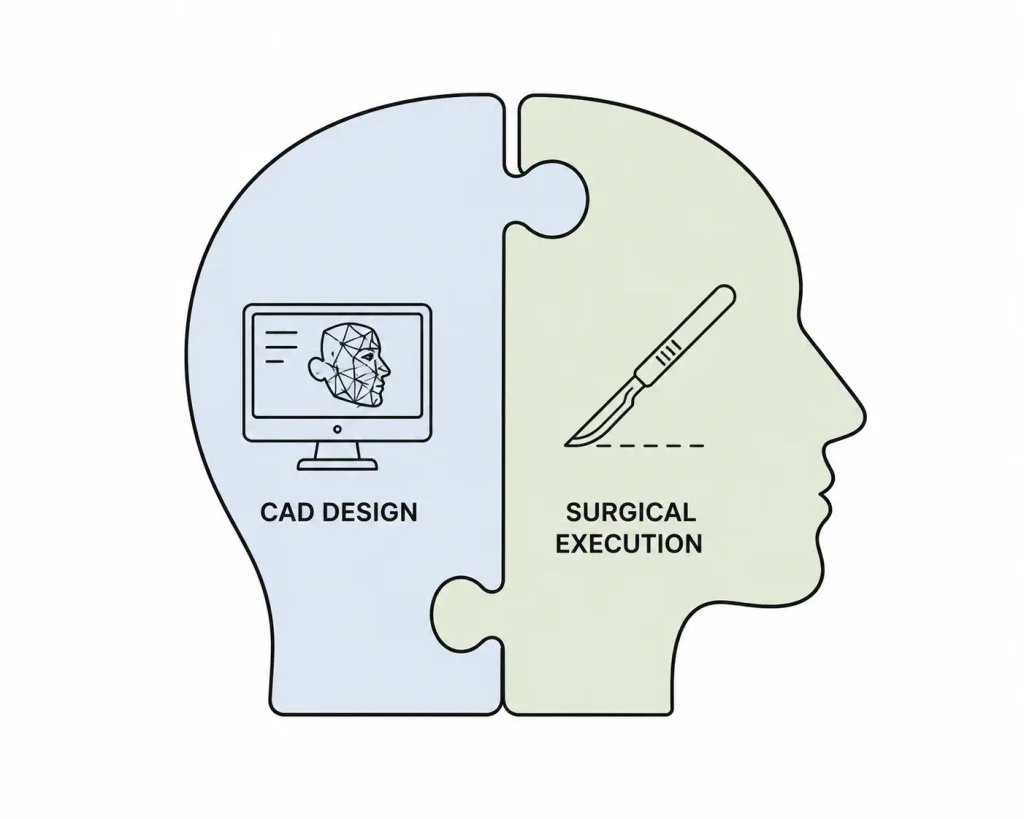
A maxillofacial or plastic surgeon is trained to work with tissue, manage bleeding, protect nerves and complete an operation safely, and to do so within the time pressures of an operating room. Three-dimensional aesthetic design is a very different discipline, one that runs on CAD skill and hours of iteration rather than operating-room instinct. Some surgeons do their own planning and do it well, but the work itself is different, and it does not compress neatly into a busy surgical schedule.
The design target is as important as the process to reach it. Studies in planning approaches showed that an exclusively skeletally driven plan, in which the only goal is the symmetry of the bone, could lead to suboptimal aesthetics and residual asymmetry, because a symmetric skeleton does not always result in a symmetric face [2].
A strong 3D implant design works backward from the finished look you want, then solves for the shape that produces it. That is a design decision, made by whoever is holding the design software, and it happens long before the first incision.
Why millimeters decide the look
Facial contouring depends on small margins. Research on patient-specific implants that were made to correct facial asymmetry showed that the planned and actual positions ended up with an average distance to the target of about half a millimetre to a millimetre, with the vast majority of the corrected surface inside of a two-millimetre threshold [3].
That’s the degree of accuracy we’re discussing. And there’s a good reason for it. Variation of 1mm or 2 in the wrong place can mean a clean, chiseled look vs a bulky one. Or an invisible transition vs a ridge you can feel with your fingers.
The design is where those transitions are smoothed out. Where that projection is shaped in context with the rest of the face. Get the numbers right on screen, and you give the surgeon a bullseye to aim for. Mess it up, and no amount of surgical artistry is going to fix that mistake.
The part that a CT scan cannot show
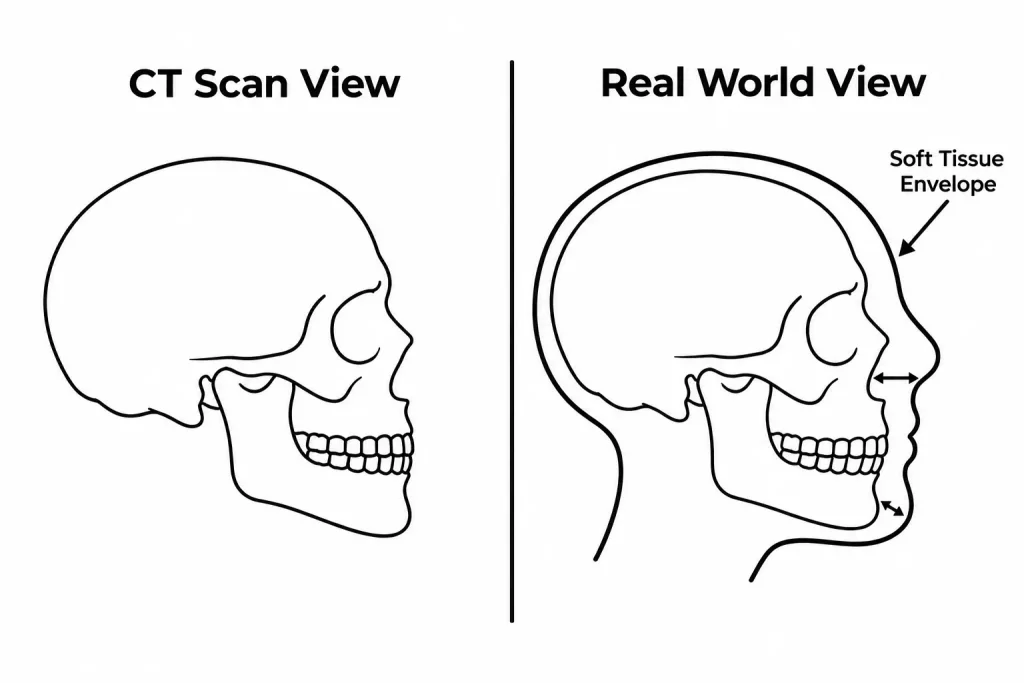
Certain clinics will manufacture a patient’s jaw implant based solely on a CT scan mailed in. It’s understandable why they do this, but that’s cutting corners with a dangerous blind spot. CBCT scans can provide you with a fantastic visualization of your hard tissue (skeleton), but they tell you nothing about your soft tissue (skin thickness, overlying fat on the jaw, muscle movement during speech/smiling). This can be problematic, as your soft tissue doesn’t just drape itself over your bone underneath [4].
Two people with the same planned bone can look different once their soft tissue drapes over it, and prediction software is at its least reliable precisely at the mobile areas like the lips and chin [5].
This is why a serious custom implant design process does not stop at the scan. It adds a live assessment of how your face actually moves and how thick the covering tissue is, so the design accounts for the drape rather than guessing at it. A scan tells you about the frame. It does not tell you about the finished surface.
The designer and the surgeon’s coordination
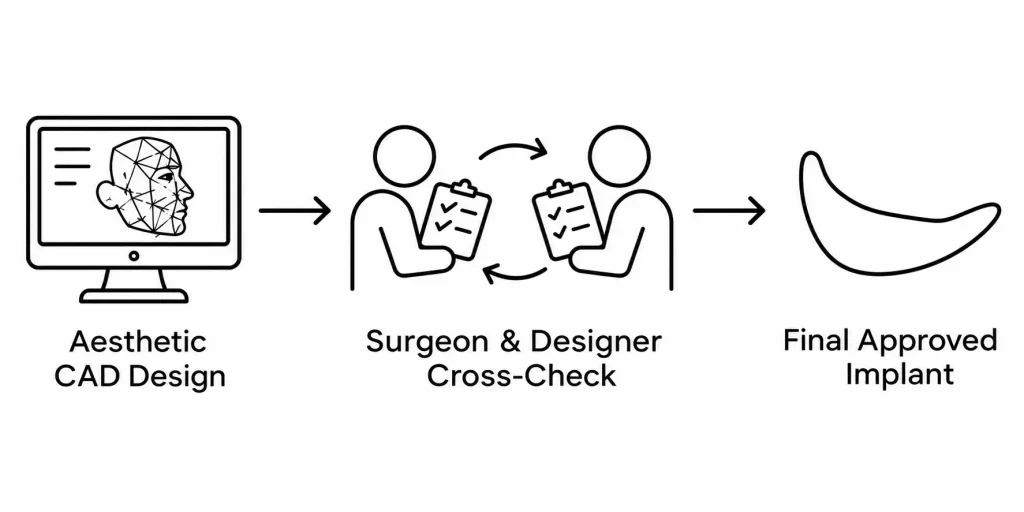
None of this replaces the surgeon. Once the design is settled, it has to survive contact with surgical reality. A good workflow has the designer and surgeon cross-check the plan together, adjusting for things like nerve clearance and where fixation screws will sit, without giving up the aesthetic goal.
The evidence backs this partnership rather than either extreme: no implant material or design has shown clear across-the-board superiority on its own, because the outcome is driven by how the implant is designed and where it is placed together.
A custom implant built from a 3D scan to fit one specific face gives the surgeon the best possible starting point, and the surgeon’s placement decides whether that potential is realised.
The bottom line
The surgeon does the executing, but the design determines what gets executed. And both better be damn good if you want a damn good result.
That is why the design phase should be given equal consideration as you would the surgeon. Not an afternoon you throw at them on some templated questionnaire. If you want a result that looks like it was meant to be on your face, scrutinize who is designing your implant and how just as much as you would a surgeon.
Facial Nexus can pair you up with an expert implant designer and maxillofacial surgeon who work together from the design phase all the way through surgery, ensuring both halves of your transformation are operating on the same sheet of music.
Contact Facial Nexus before you make any permanent decisions. Let’s nail down the design first.
Frequently asked questions
Is the implant design really as important as the surgeon?
They are two halves of one outcome. The design sets the target, deciding the exact shape, projection, and symmetry your face is meant to end up with, and the surgeon decides whether that target is hit during the operation. A flawless plan placed badly fails, and a perfect placement of a poorly designed implant fails too. Neither is more important than the other.
Is it possible to design a custom implant from simply a CT scan that I mail in?
It can, but it should not be the whole basis of the design. A CT or CBCT scan captures your bone in detail, and nothing about the soft tissue over it, yet that soft tissue is what the world actually sees, and its shape does not simply track the bone. A design built on the scan alone is working with half the picture, which is why an in-person or video assessment of your soft tissue and facial movement is part of a careful process.
How much does a single millimetre actually matter?
Face contouring makes all the difference. Patient-specific implants are designed and placed about one to two millimetres from your target area intentionally. On such a small scale, one millimetre of overprojection or a small amount off on the edge of your implant is what separates a natural, crisp result from one that looks swollen or has a visible border. Precision in design creates these margins.
Who designs custom facial implants, the surgeon or a specialist?
Either can, and practices differ. Some surgeons plan their own cases, while others work with a dedicated implant designer whose whole focus is the 3D design. What matters is not the job title but that the design is done carefully, aimed at the finished look rather than just the bone, and cross-checked against surgical feasibility before anything is manufactured.
References
- Lee YJ, Oh JH, Kim SG. Virtual surgical plan with custom surgical guide for orthognathic surgery: systematic review and meta-analysis. Maxillofac Plast Reconstr Surg. 2024;46(1):39.[↩]
- Lee J, Kim D, Xu X, Kuang T, Gateno J, Yan P. Predicting optimal patient-specific postoperative facial landmarks for patients with craniomaxillofacial deformities. Int J Oral Maxillofac Surg. 2024;53(11):934-941.[↩]
- Buchholzer S, Moissenet F, Aymon R, Scolozzi P. Refining orthognathic outcomes: 3D accuracy with patient-specific implants for facial asymmetry correction. JPRAS Open. 2025;45:95-108.3[↩]
- Malá PZ, Krajíček V, Velemínská J. How tight is the relationship between the skeletal and soft-tissue facial profile: a geometric morphometric analysis of the facial outline. Forensic Sci Int. 2018;292:212-223.[↩]
- Chen CYH, Xi T, Ko EWC, Tsao SY. Accuracy of 3D simulation in soft tissue change after orthognathic surgery in class III malocclusion: influence of different vertical facial patterns. J Craniomaxillofac Surg. 2025;53(12):2133-2141.[↩]