
A strong jawline is not determined by width alone. When jaw angle implants are considered, the anatomy of the lower face needs to be assessed as a whole.
Jaw appearance depends on several anatomical features working together: bigonial width, gonial angle, vertical ramus height, chin projection, and masseter muscle development. Studies using CT and cephalometric measurements have shown relationships among mandibular width, ramus height, mandibular angles, and masseter size. [1] For mandibular angle augmentation, these measurements can therefore be considered together when planning the desired contour.
Key Takeaways
- Jaw angle implants do more than simply add width. The final appearance also depends on bigonial width, the gonial angle, vertical ramus height, chin projection, and the surrounding soft tissue. These features need to be considered together when planning augmentation.
- Standard implant options may not address every patient’s anatomy equally well. Patient-specific implants can be designed around the individual’s bone structure and can be used when the planned correction involves changes in more than one dimension.
- A wider jaw does not always mean a more defined jawline. The relationship between the jaw angles, ramus, chin, and soft tissues affects the final result, so implant size should be chosen in the context of the patient’s overall lower face proportions.
- Jaw angle implants are a surgical procedure and complications can occur. Published studies have reported problems such as infection and implant displacement, with complication rates varying between studies and implant types.
What the jawline actually is, anatomically
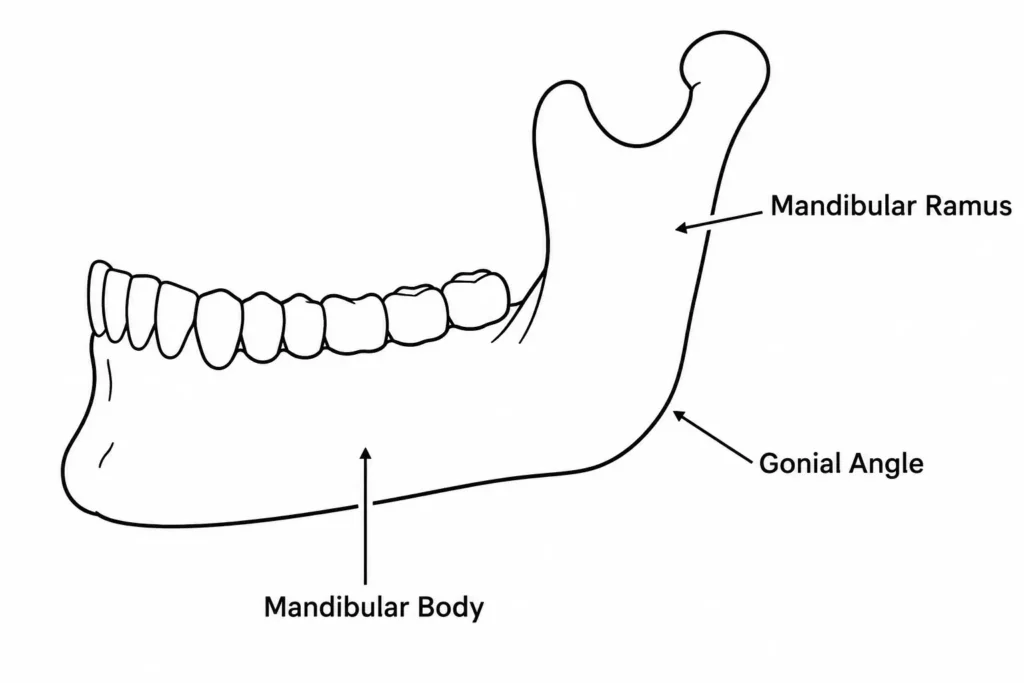
The mandible has a horizontal body and two vertical rami. The ramus meets the body at the mandibular angle, also called the gonial region. These structures form much of the bony framework of the lower face, while the overlying muscles and soft tissues affect the contour seen externally.
Jaw angle implants are used to augment the mandibular angle. Published surgical literature describes silicone implants placed through an intraoral incision, with implantation at the mandibular angle in a subperiosteal plane [2] [3].
Silicone implants are among the alloplastic materials used for facial skeletal augmentation, while patient-specific titanium angle implants have also been described for improving jawline definition [4] [5].
Bigonial width: the horizontal dimension
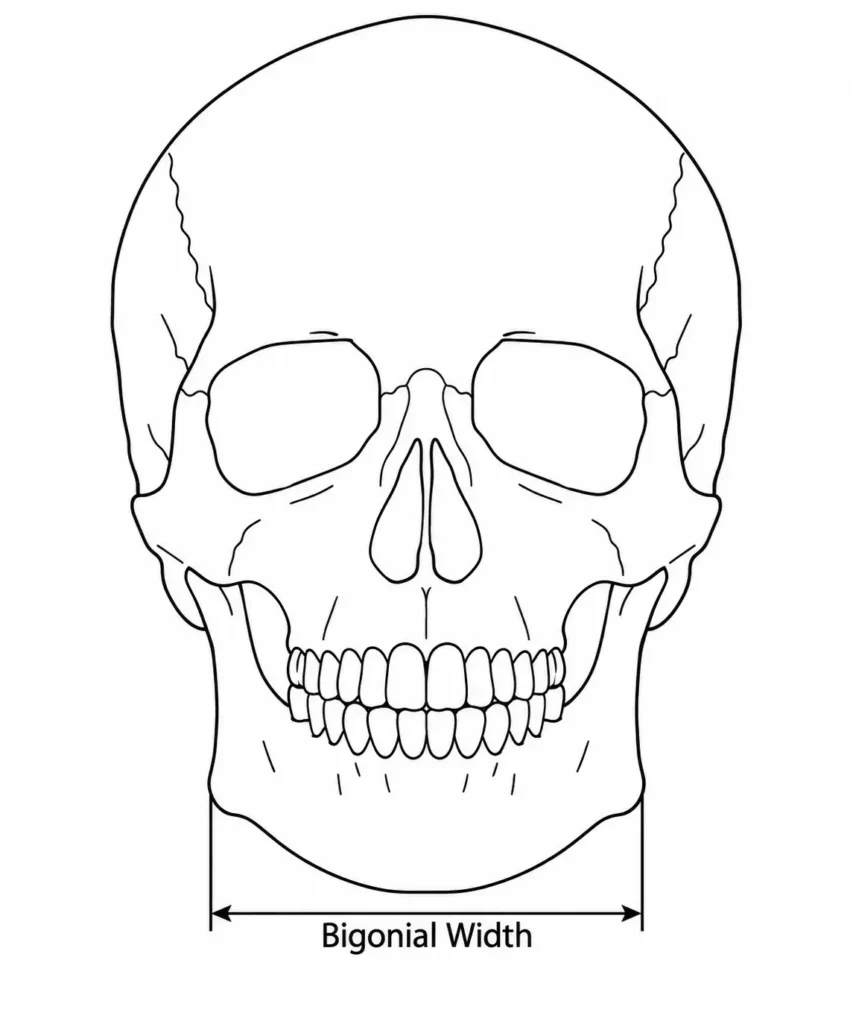
Bigonial width is the distance between the two gonion landmarks at the mandibular angles. It is an important horizontal measurement of the lower face and can be changed by mandibular angle implants. CT-based research has included mandibular width and lateral flare among measurable mandibular characteristics and found that these measurements are related to masseter volume.
Because facial width is produced by both bone and soft tissue, the same bony measurement can look different in different patients. In a CT study, masseter volume and thickness were related to mandibular width and lateral flare. This is one reason implant planning needs to consider the soft-tissue envelope as well as the underlying bone.
An internet survey of preferences for the ideal male jaw angle found that preferred intergonial width was similar to facial width. The study also evaluated the vertical position and curvature of the jaw angle, showing that width was considered alongside other parts of jaw shape rather than as an isolated measurement [6].
Gonial angle: the corner that shapes the jaw
The gonial angle is the angle formed by the mandibular ramus and body. It is commonly assessed on lateral cephalometric images [7].
There is no single gonial angle that defines an attractive jaw for every patient. In an internet survey focused on the male jaw, the preferred profile gonial angle was 130°. The same study assessed intergonial width, vertical jaw position, jawline slope, ramus slope, and curvature, showing that several features were considered when assessing preferred jaw-angle appearance [6].
CT-based measurements have also found differences in mandibular angles between male and female groups, with more acute mandibular angles in males in that study. These findings provide reference data, but they should not be treated as universal targets for every patient.
Vertical ramus height: an often overlooked dimension
Vertical ramus height describes the height of the mandibular ramus. It is one of the measurements that can be assessed on maxillofacial CT and has been studied alongside mandibular width, lateral flare, and masseter volume.
Patient-specific angle implants can be useful when the desired change involves more than lateral width. In a 2025 study of 18 patients undergoing orthognathic surgery, patient-specific titanium angle implants were planned with computer-assisted methods. The authors reported measurable improvement in jaw angle parameters and a mean volumetric angle expansion of 4.6 mm [8]
The same study noted that conventional mandibular osteotomies mainly allow sagittal movements and do not directly modify ramus height. Patient-specific implants were therefore investigated as a way to address jawline changes that standard osteotomies may not fully provide.
Chin projection: the front anchor
The chin forms the anterior part of the lower-face profile, while the mandibular angles form the posterior portion. Chin position therefore affects the overall profile of the lower face.
A study by Naini and colleagues proposed the lower lip-chin prominence angle as a way to assess sagittal chin position. The authors found that increasing retrusion or prominence away from their reference position was associated with lower perceived attractiveness and greater desire for surgical correction in the groups studied [9].
These findings support assessing chin projection as part of facial analysis rather than considering the jaw angles on their own. The amount of chin augmentation or repositioning still needs to be determined from the patient’s individual facial measurements.
Masseter muscle development: the soft tissue layer
The masseter is a major muscle of mastication and attaches around the mandibular angle and ramus. Its size is relevant to the external appearance of the lower face.
Masseter muscle development is relevant when assessing jaw width because CT studies have found relationships between masseter volume and mandibular width, lateral flare, and ramus height. Ultrasound research has also demonstrated substantial variation in masseter thickness between individuals and a relationship between masseter thickness and facial morphology.
Studies have examined the relationship between masseter volume and bigonial width. When planning jaw angle implants, the soft-tissue component should therefore be considered alongside the skeletal target.
The same principle applies when comparing male and female mandibular anatomy. In the CT study by Perez and colleagues, males had greater masseter volume and thickness, while mandibular angle measurements also differed between groups.The study was designed to provide baseline measurements for lower-face surgical planning, rather than establish a single ideal facial shape. This distinction is useful when discussing lower face proportions, because population measurements describe patterns across groups but do not determine the correct implant dimensions for an individual patient. That decision still depends on the patient’s anatomy, clinical examination, and individual treatment goals for augmentation before final implant design.
Why jawline definition depends on proportions
Jawline appearance depends on the relationship between mandibular dimensions and the surrounding soft tissues. CT-based research has shown that mandibular width, ramus height, lateral flare, mandibular angles, and masseter volume are measurable features that vary between individuals.
The male jaw-angle survey also supports looking at several measurements together. In that study, observers evaluated gonial angle, intergonial width, vertical position, jawline slope, and curvature when judging preferred jaw-angle appearance.
Patient-specific planning takes the same general approach into three dimensions. The 2025 titanium implant study used computer-assisted planning and postoperative 3D facial photographs to evaluate changes in jaw-angle shape [8].
How surgeons assess the jaw before augmentation
An assessment begins with the patient’s existing facial structure. CT-based studies can measure mandibular width, ramus height, lateral flare, mandibular angles, and masseter volume in the same patient. Three-dimensional facial photography can then be used to evaluate the external soft-tissue contour and compare it with the planned skeletal change.
This distinction matters because an implant changes the underlying framework, while the final visible contour also includes the surrounding soft tissues. Implant planning can therefore consider whether the desired change is mainly wider, vertically longer, or more angular overall.
What to expect from jaw angle implant surgery
Jaw angle implants can be placed through an intraoral incision. A prospective clinical study evaluated bilateral silicone implants for mandibular angle augmentation, while an earlier surgical report described intraoral placement and creation of a subperiosteal pocket at the mandibular angle.
Silicone implants are used for mandibular angle augmentation. Infection and implant displacement have been reported as postoperative complications.
In one prospective study of 58 patients who received 116 silicone mandibular angle implants, 5 implants became infected and 16 were displaced during the study follow-up. The authors also reported patient satisfaction among patients without complications.
Complication rates vary between studies and implant types. A 2025 systematic review and meta-analysis of alloplastic facial skeletal implants included 48 studies and 4,139 implants and reported an overall complication rate of 10.7%. The authors reported complication rates of 2.78% for silicone and 2.48% for Medpor across the included literature [10].
Custom patient-specific implants offer another option when the planned change requires precise control of the mandibular angle. In the 2025 study described above, patient-specific titanium implants were designed using computer-assisted planning and produced measurable changes in jaw-angle volume and parameters [8].
The bottom line
Jaw angle implants can increase mandibular angle width and alter the contour of the lower face. Their effect depends on the implant itself as well as the underlying mandibular shape and overlying soft tissues. Bigonial width, gonial angle, vertical ramus height, chin projection, and masseter muscle development are all relevant measurements when assessing the lower face.
For jawline augmentation, the aim is to plan the implant around the patient’s anatomy rather than rely on a single measurement. Studies of aesthetic preferences and patient-specific implants support evaluating the mandibular angle in three dimensions and considering its relationship with the rest of the face.
If you are planning to undergo a jaw angle implant surgery, contact FacialNexus today. We will connect you with best surgeons who will use the most suitable materials for you.
Frequently asked questions
What are jaw angle implants?
Jaw angle implants are implants placed over the mandibular angle to change the width and contour of the back part of the jaw. They can be made from materials such as silicone, polyethylene, or titanium.
Do jaw angle implants only make the jaw wider?
No. The planned change can involve width, the shape of the mandibular angle, or the vertical dimension of the jaw. Patient-specific implants can be designed to address several of these features at the same time.
Are custom jaw implants different from standard implants?
Yes. Custom implants are designed from the patient’s own imaging and can be shaped to match the existing mandibular anatomy. This can be useful when the desired correction is more complex than a simple increase in width.
What are the possible risks of jaw angle implants?
Reported complications include infection and implant displacement. Other complications can occur depending on the implant, surgical technique, and individual patient factors.

References
- Perez PI, Hendershot K, Teixeira JC, Hohman MH, Adidharma L, Moody M, et al. Analysis of Cephalometric Points in Male and Female Mandibles: An Application to Gender-Affirming Facial Surgery. J Craniofac Surg. 2023;34(4):1278-1282. doi:10.1097/SCS.0000000000009189. PMID: 36727677.[↩]
- Al-Jandan B, Marei HF. Mandibular angle augmentation using solid silicone implants. Dent Med Probl. 2018;55(4):367-370. doi:10.17219/dmp/99531. PMID: 30648361.[↩]
- Aiache AE. Mandibular angle implants. Aesthetic Plast Surg. 1992;16(4):349-354. doi:10.1007/BF01570699. PMID: 1414661.[↩]
- Rios O, Pradel R, Pradel J, Lerhe B, Savoldelli C. Jawline improvement using patient-specific angle implants with virtual planning in orthognathic surgery. J Craniomaxillofac Surg. 2025;53(5):507-515. doi:10.1016/j.jcms.2025.01.024. PMID: 39875225.[↩]
- Abdulaziz MKH, Kamal M, Kolaityte V, Aziz H. Complications of alloplastic facial skeletal implants in aesthetic surgery: A systematic review and meta-analysis. J Plast Reconstr Aesthet Surg. 2025;107:5-18. doi:10.1016/j.bjps.2025.04.042. PMID: 40499276.[↩]
- Mommaerts MY. The ideal male jaw angle: An Internet survey. J Craniomaxillofac Surg. 2016;44(4):381-391. doi:10.1016/j.jcms.2015.12.012. PMID: 26888465.[↩][↩]
- Tiwari, P., Bera, R., & Chauhan, N. (2020). Magnitude of Gonial Angle Influence on the Commonness of Mandibular Angle Fractures. Annals of Maxillofacial Surgery, 10(1), 190–194. https://doi.org/10.4103/ams.ams_23_20[↩]
- Rios O, Pradel R, Pradel J, Lerhe B, Savoldelli C. Jawline improvement using patient-specific angle implants with virtual planning in orthognathic surgery. J Craniomaxillofac Surg. 2025;53(5):507-515. doi:10.1016/j.jcms.2025.01.024. PMID: 39875225.[↩][↩][↩]
- Naini FB, Garagiola U, Wertheim D. Analysing chin prominence in relation to the lower lip: The lower lip-chin prominence angle. J Craniomaxillofac Surg. 2019;47(8):1310-1316. doi:10.1016/j.jcms.2019.06.002. PMID: 31331858.[↩]
- Abdulaziz MKH, Kamal M, Kolaityte V, Aziz H. Complications of alloplastic facial skeletal implants in aesthetic surgery: A systematic review and meta-analysis. J Plast Reconstr Aesthet Surg. 2025;107:5-18. doi:10.1016/j.bjps.2025.04.042. PMID: 40499276.[↩]