
Most patients who look into custom PEEK facial implants will have some sort of deformity that they would like to correct. It could be lack of angularity in their jaws. Lack of chin projection. Facial asymmetry. Lack of projection in their midface. Or maybe they had another implant placed in the past and want it revised to give them a better contour.
There are many publications that show patient specific PEEK implants for these defects. However just because someone has a contour defect doesn’t mean they are a candidate for surgery. [1] [2] [3] [4] [5] [6] [7]
What we should ask ourselves is can that deformity be corrected with a patient specific implant? We must evaluate the bony anatomy of the face, surrounding soft tissue, previous procedures, desired outcome and treatment options. [1] [2] [8]
Key takeaways
- Custom PEEK facial implants can be designed from three-dimensional imaging around an individual’s anatomy and planned contour.
- There is research on patient specific facial implants. These include but are not limited to mandible contour defects, microgenia, facial asymmetry or malformation and some cheek and nasal defects.
- If a patient has had previous implant placement it can play a role if there is still a defect with contour, symmetry, implant placement or implant to anatomic relation.
- There are many beneficial qualities to PEEK when imaging and as a material however we cannot state that it is better than all other implant materials.
What does candidacy for a custom PEEK implant actually mean?
A defined structural problem is the starting point
Patient-specific implants are most useful when there is a three-dimensional contour or structural problem that can be planned against the patient’s anatomy. Published PEEK workflows have used CT imaging, virtual implant design, computer-aided manufacturing, and computer-assisted placement to create implants for individual facial structures. [1] [2] [8]
With a patient-specific design, the implant geometry can be planned around the patient’s existing anatomy and the intended contour before surgery. Some workflows also incorporate soft-tissue simulation when refining the implant shape. [2] [8]
PEEK is a material choice, not a diagnosis
There are multiple materials used for craniofacial reconstruction and augmentation. A recent review from 2024 lists many advantages of using PEEK including its ability to withstand mechanical forces and being CT and MRI compatible. However there is no implant that is better than all others when it comes to facial implants. [1]
Another study in 2026 that performed a systematic review and meta analysis of patient specific implants using PEEK and Titanium showed similar results when looking at complications. They found no material to be superior over another when comparing complications, infection, explantation, healing time, implant location and patient satisfaction. [9]
Weak jaw angles and mandibular contour
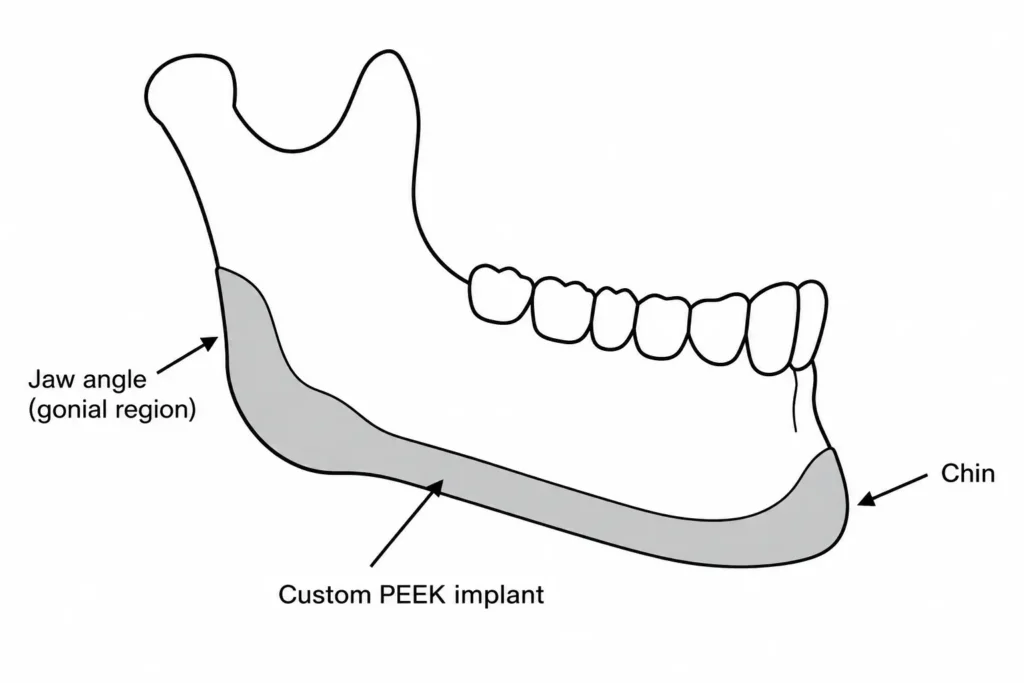
When the mandibular contour is deficient
Weak mandibular angles can be addressed with augmentation of deficient mandibular contours. Patient-specific PEEK implants have been studied for mandibular angle augmentation using three-dimensional CAD/CAM planning. [3] [4]
In one study, six patients received seven PEEK patient-specific implants for local mandibular contour defects, including three deficient chins and four mandibular angles. [4]
A custom design may be useful when the planned change involves a particular part of the mandibular contour or a transition between adjacent areas. The surgeon first needs to define the actual anatomical deficiency and the amount of augmentation required. [3] [4] [8]
Limited chin projection
When the chin needs structural augmentation
Limited chin projection is another reason a patient may discuss a custom implant. The PEEK series by Atef and colleagues included deficient chins as well as mandibular angles, with the implants designed from the patient’s anatomy. [4]
A patient-specific approach allows the implant geometry to be designed around the existing chin rather than relying on a preformed shape. Another PEEK workflow incorporated soft-tissue simulation when refining the implant design. [2]
An implant is not automatically the correct treatment for every retruded chin. Clinical evaluation should distinguish isolated chin deficiency from more extensive mandibular retrusion or skeletal deformity. In some patients, genioplasty or orthognathic surgery may need to be considered. Facial proportions and the relationship of the chin to the rest of the face are important during this assessment. [10] [11]
Facial asymmetry
When the two sides of the face differ
Facial asymmetry can be one reason for patient-specific planning because the implant can be designed around the patient’s actual anatomy rather than a standard shape. Patient-specific facial implant literature includes correction of facial deformities and residual facial imbalance, while facial implant guidance also recognizes asymmetry as an indication for implant-based correction. [5] [7] [8]
The goal is not necessarily to create two mathematically identical sides. The surgeon needs to evaluate the anatomical pattern of the asymmetry and define what the implant is intended to correct. [8]
A flat midface or underdeveloped cheekbones
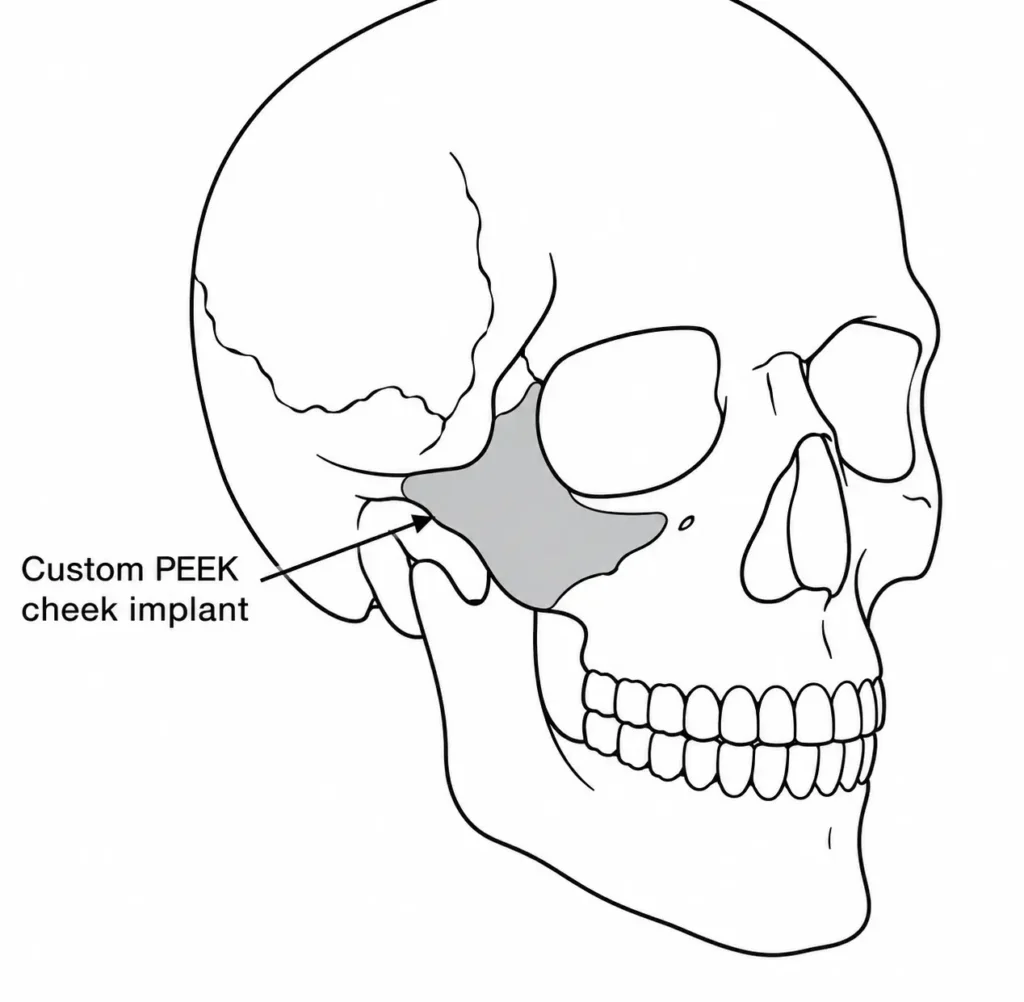
Malar and paranasal contour deficiencies
Patient-specific PEEK implants have also been reported in the malar and midface regions. One aesthetic case involved a patient with malar hypoplasia who had undergone three previous silicone implant procedures and remained dissatisfied with symmetry and the palpable implant rim. The replacement treatment used bone-anchored PEEK implants planned from three-dimensional CT imaging. [5]
Other clinical work has described patient-specific PEEK implants for paranasal deficiencies. In that study, the implants and surgical guides were manufactured from CT-based computer planning, with postoperative CBCT used to assess the result. [6]
For underdeveloped cheekbones or other midface deficiencies, the surgeon needs to evaluate the underlying anatomy and the intended contour before selecting the implant design. The material itself is only one part of that decision. [1] [5] [6] [8]
Dissatisfaction with a previous facial implant
When revision needs a different contour
Previous implant surgery does not automatically exclude someone from a custom PEEK approach. A published case describes secondary malar augmentation with custom PEEK after three previous silicone implant operations. [5]
The reason for dissatisfaction matters. A problem may involve implant shape, position, contour, symmetry, or the way the implant relates to the underlying anatomy. A custom implant may be considered when the surgeon determines that further implant-based treatment is appropriate. [5] [8]
Revision planning also needs to account for the patient’s existing anatomy and the changes created by previous procedures. Patient-specific planning does not eliminate the need for careful assessment of the tissues or the limitations created by earlier surgery. [8]
What the surgeon needs to assess before surgery
Health, anatomy, expectations, and alternatives
Someone who is interested in getting a custom PEEK implant. AAFPRS facial implant guidance list some of these steps for you to follow. They should be looking at your medical history and past surgical history. Exam your body and speak about what you want. And learn about the procedure and possible complications.
There are many other factors listed on the guidance. Some include but are not limited to health. Facial development, amount of bone to support the implant. Ability to heal, smoking and current infection.
The surgeon also needs appropriate three-dimensional imaging when the implant is being designed around the patient’s anatomy. Published PEEK workflows commonly use CT-based anatomy for implant planning, with some also incorporating virtual simulation and computer-assisted placement. [1] [2] [6] [8]
Whether PEEK is suitable for the specific case
PEEK should not be presented as an automatic upgrade over every other implant material. Current reviews support its use in selected craniofacial applications but also describe limitations and the absence of evidence that one material is universally superior. [1] [9]
Depending on the underlying diagnosis, treatment may involve PEEK, another implant material, chin surgery, orthognathic surgery, or another approach altogether. The appropriate option depends on the diagnosis, anatomy, goals, and risks. [9] [10] [11].
Read our PEEK vs silicone facial implants guide to learn more.
The bottom line
You may have a reason to discuss custom PEEK facial implants if you have weak jaw angles, limited chin projection, facial asymmetry, a malar or midface deficiency, or dissatisfaction following an earlier facial implant.
Published reports describe patient-specific PEEK planning for a range of facial structural problems, but much of the evidence consists of small clinical series and case reports rather than large comparative trials. [1] [2] [3] [4] [5] [6] [7] [9]
These features do not establish candidacy by themselves. Final suitability must be assessed by a qualified surgeon who can examine the face, review appropriate imaging, consider alternatives and risks, and determine whether a custom PEEK implant is appropriate for the specific anatomy and treatment goal.
Facial Nexus can coordinate your connection with an independent implant designer and qualified surgeon. Contact us today.
Frequently asked questions
Who is a good candidate for custom PEEK facial implants?
If you have a deformity that could benefit from a custom implant then you may be a candidate. Some examples include but are not limited to low jaw line, lack of chin projection, some facial abnormalities and some mid face defects. After evaluation of your medical history, anatomy, expectations and options we can determine if a custom PEEK implant is right for you.
Can custom PEEK implants help with asymmetry?
If you have asymmetry or imbalance of the face custom patient specific implants can help. They can be made to your unique anatomy. There will still need to be an assessment of what type of asymmetry you have and why by your surgeon.
Can PEEK implants be used after a previous facial implant?
They can be considered in selected revision cases. A published aesthetic case describes custom PEEK implantation after three previous silicone malar implant procedures. Suitability depends on the anatomy, previous surgical changes, and the reason additional treatment is being considered.
Is PEEK better than other facial implant materials?
Current evidence does not establish PEEK as universally superior. It has useful mechanical and imaging characteristics, but material selection should be individualized to the treatment site and clinical circumstances.

References
- Kauke-Navarro M, Knoedler L, Knoedler S, Deniz C, Stucki L, Safi AF. Balancing beauty and science: a review of facial implant materials in craniofacial surgery. Front Surg. 2024;11:1348140. doi:10.3389/fsurg.2024.1348140.[↩][↩][↩][↩][↩][↩][↩][↩]
- Guevara-Rojas G, Figl M, Schicho K, Seemann R, Traxler H, Vacariu A, et al. Patient-specific polyetheretherketone facial implants in a computer-aided planning workflow. J Oral Maxillofac Surg. 2014;72(9):1801-1812. doi:10.1016/j.joms.2014.02.013.[↩][↩][↩][↩][↩][↩][↩]
- Olate S, Uribe F, Huentequeo-Molina C, Goulart DR, Sigua-Rodriguez EA, Alister JP. Mandibular angle contouring using porous polyethylene stock or PEEK-based patient specific implants. A critical analysis. J Craniofac Surg. 2021;32(1):242-246. doi:10.1097/SCS.0000000000006926.[↩][↩][↩][↩]
- Atef M, Mounir M, Shawky M, Mounir S, Gibaly A. Polyetheretherketone patient-specific implants for the reconstruction of two different mandibular contour deformities. Oral Maxillofac Surg. 2022;26(2):299-309. doi:10.1007/s10006-021-00984-6.[↩][↩][↩][↩][↩][↩]
- Narciso R, Basile E, Bottini DJ, Cervelli V. PEEK implants: an innovative solution for facial aesthetic surgery. Case Rep Surg. 2021;2021:5518433. doi:10.1155/2021/5518433.[↩][↩][↩][↩][↩][↩][↩]
- Zhang J, Li D, Liu Y, Zhang Z, Fan Y, Shi J, et al. Application of patient-specific PEEK implant for aesthetic considerations in paranasal augmentation. J Craniofac Surg. 2022;33(8):e877-e880. doi:10.1097/SCS.0000000000008824.[↩][↩][↩][↩][↩]
- Saponaro G, Todaro M, Barbera G, Scivoletto G, Foresta E, Gasparini G, et al. Patient-specific facial implants in polyetheretherketone and their stability: a preliminary study. Ann Plast Surg. 2023;90(6):564-567. doi:10.1097/SAP.0000000000003527.[↩][↩][↩]
- Saponaro G, Paolantonio C, Barbera G, Foresta E, Gasparini G, Moro A. Our problems and observations in 3D facial implant planning. Maxillofac Plast Reconstr Surg. 2022;44(1):32. doi:10.1186/s40902-022-00362-6.[↩][↩][↩][↩][↩][↩][↩][↩][↩][↩]
- Steengaard RK, Ørholt M, Herly M, Vester-Glowinski PV, Kofod T. Complications after patient-specific implants for facial contouring and augmentation: a systematic review and meta-analysis. Plast Reconstr Surg Glob Open. 2026;14(7):e7911. doi:10.1097/GOX.0000000000007911.[↩][↩][↩][↩]
- Rosen HM. Aesthetic guidelines in genioplasty: the role of facial disproportion. Plast Reconstr Surg. 1995;95(3):463-469. doi:10.1097/00006534-199503000-00004.[↩][↩]
- Arroyo HH, Olivetti IP, Lima LFR, Jurado JRP. Clinical evaluation for chin augmentation: literature review and algorithm proposal. Braz J Otorhinolaryngol. 2016;82(5):596-601. doi:10.1016/j.bjorl.2015.09.009.[↩][↩]