
If you’re going to another country to receive your PEEK facial implants abroad, there are some things to keep in mind when traveling. The CDC lists recommendations if you plan to receive medical treatment abroad. Research the area and facility and doctor that will be performing the procedure. Be aware of what complications can happen from traveling and having surgery. Have follow up scheduled and know how to get a copy of your records. [1]
There has been literature describing PEEK as a patient specific implant used in facial reconstruction and augmentative procedures. There were 32 articles that were found when looking at a systematic review published in 2024. These included 194 patients. Many articles were case reports. [2]
Key takeaways
- Find out what your surgeons specialize in and know the hospital you will be going to.
- Take time off after surgery to heal, don’t schedule surgery on your vacation. The CDC and ASPS advise against exercise swimming or sun bathing on tours.
- Ask your doctor how soon you can fly home. Flying can cause blood clots as well as surgery.
- Make sure you have follow up scheduled when you return home. Make sure you have all your records before leaving.
- Know what you will do if you have a complication. Who will take care of you once your at home.
Choosing the surgeon for PEEK facial implants abroad
Look beyond photographs and online marketing
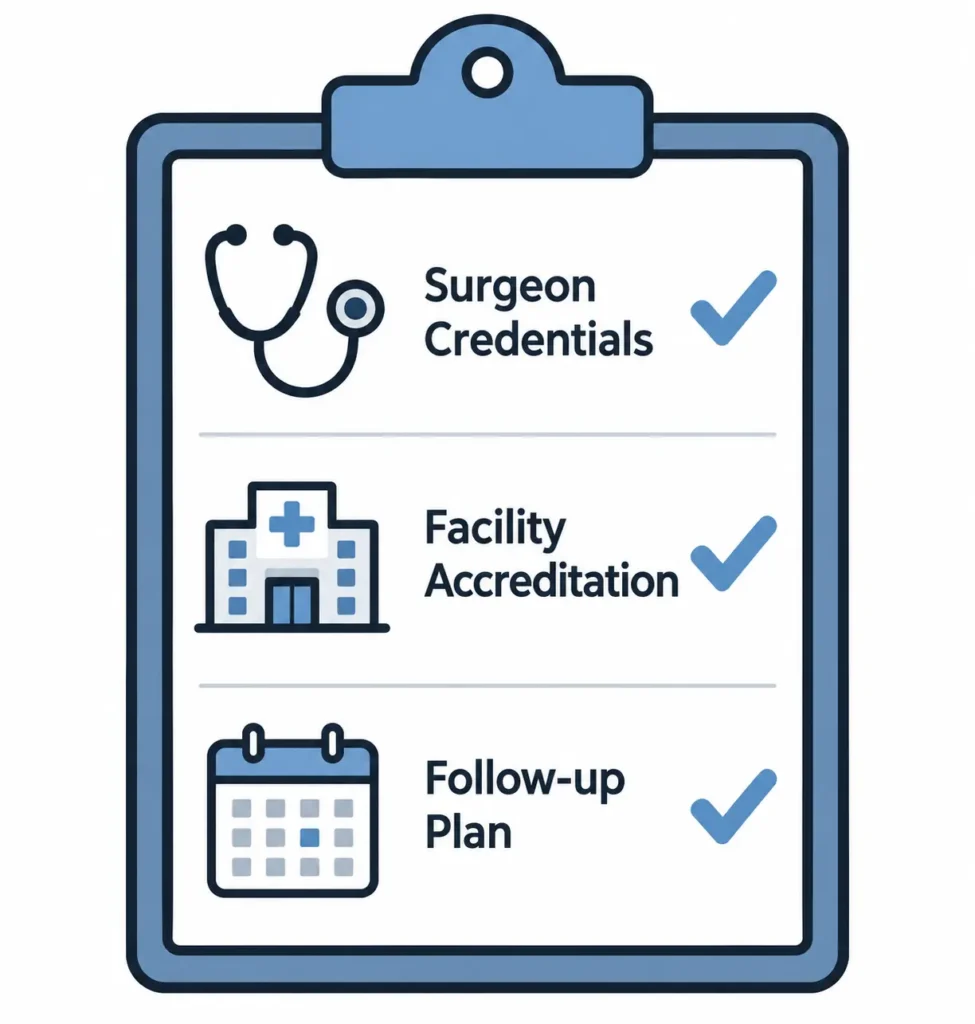
Make sure you know who your surgeon is before traveling. The American college of surgeons recommends researching who is qualified to perform surgery and anesthesia when receiving care in another country. They also advise to be informed on the medical/social/cultural and legal issues of receiving care abroad. [3]
With custom PEEK implants you should ask your surgeon what their knowledge and experience is with patient specific implants and anatomy of the face. There has been published research on using CT scans and cone beam CT scans to plan for these implants. [4]
You should make sure you know who will be performing your surgery and who will see you after.
Checking clinic and hospital standards
Accreditation is useful, but it is not a guarantee
The CDC advises medical tourists to research the facility and treating healthcare professionals. It notes that standards for facility accreditation and healthcare professional certification vary between countries. CDC also reports that medical tourists should consider using internationally accredited facilities and warns that accreditation does not guarantee a good outcome. [1]
The ACS similarly encourages patients receiving treatment abroad to seek care at healthcare institutions that have met standards established by recognized accrediting organizations. [3]
Ask where the operation will actually take place. A consultation office and a surgical facility may be different locations. You should also know where follow-up will occur and who will manage a postoperative problem.
Understand what is included
CDC advises medical tourists to understand which services are included in the procedure cost and notes that some overseas providers charge additional fees for follow-up care. It also advises patients to determine whether follow-up is scheduled at the same facility where the procedure is performed. [1]
Before traveling, clarify the financial arrangements for follow-up and any additional treatment.
Planning the trip around surgery
Recovery should determine the itinerary
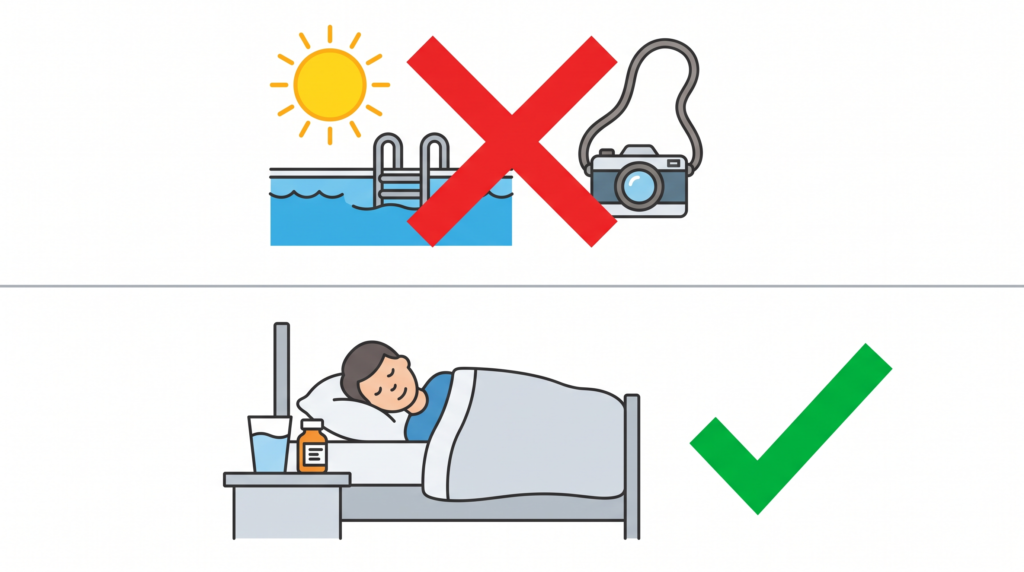
ASPS advises patients recovering from cosmetic surgery to avoid vacation activities such as sunbathing, swimming or snorkeling, extensive tours, and exercise. CDC similarly states that strenuous activity, exercise, sunbathing, swimming, and long tours during the postoperative period can delay or impede healing. [1] [5]
This guidance is not specific to PEEK facial implants, so it should not be treated as a PEEK-specific recovery schedule.
The appropriate recovery period should be discussed with the surgeon performing the procedure.
Think about the return flight
CDC states that air travel and surgery independently increase the risk of blood clots. It also states that travel after surgery further increases this risk because passengers may remain seated for long periods during a hypercoagulable postoperative state. [1]
CDC also reports that ASPS recommends waiting 7–10 days after cosmetic procedures involving the face, eyelids, or nose before flying. This recommendation applies to those cosmetic procedures and should not be assumed to represent a specific travel interval for every PEEK facial implant operation. [1]
Do not let a fixed return ticket determine when you are medically ready to travel.
Accommodation and local support
Stay somewhere practical for recovery
Make sure you can easily access doctors if you need them after your operation. Know where you will go to get food, medicine and any follow up care.
You may want someone around during the initial stages of your recovery as well depending on what work you have done.
Do not plan a sightseeing holiday
The ASPS states that there are many things that you should not do when recovering from plastic surgery. Swimming, working out in the sun, touring etc. [5]
When traveling to have surgery done, plan your recovery time away from your holiday.
Communication matters
Make sure you can communicate with the medical team
The ACS identifies language and cultural barriers as potential problems in medical care abroad because they may impair communication with physicians and other caregivers. It also identifies differences in medical records and limited opportunity for follow-up with the treating physician or surgeon as potential issues. [3]
Before surgery, make sure you know how to contact the surgeon and clinic about postoperative concerns. Written postoperative instructions can also be useful for medications, restrictions, and warning signs.
Aftercare and follow-up need to be planned before travel
Know who will see you after surgery
CDC advises medical tourists to discuss the plan for addressing complications with both the healthcare professional performing the procedure abroad and their healthcare professional at home. [1]
The ACS recommends organizing follow-up care at home before travel whenever possible. [3]
That means the follow-up plan should be discussed before leaving home rather than created only after a problem develops.
Take your records home
CDC recommends requesting copies of overseas medical records in English and providing them to healthcare professionals involved in subsequent follow-up. [1]
The ACS also recommends obtaining a complete set of medical records before returning home so that details of the treatment are available to physicians and surgeons providing later care. [3]
For an implant procedure, keep your operative report, implant information, imaging, and medication information whenever these records are provided.
What happens if a complication develops?
Have a plan before the problem occurs
The facial-implant literature reports complications across different materials and anatomical sites. A 2025 systematic review found a 4.4% overall complication rate, with nerve injuries and infections most common. [6]
PEEK-specific studies have also reported complications. A systematic review of 32 articles involving 194 patients reported complications including infection, nerve symptoms, aesthetic problems, hematoma or seroma, entropion, and diplopia. [2] A 10-patient study reported three complications: recurrent edema, mental nerve paresthesia, and recurrent sinusitis. [4]
These studies involved different procedures and patient groups, so their findings should not be combined into one PEEK complication rate.
If you choose to travel for your follow up it may be more difficult. Patients have been seen with infections that require long courses of antibiotics, hospitalizations and even surgery after having cosmetic surgery abroad. There have also been other complications reported after facial surgeries. [7] [8]
Have a plan on where you will go for medical attention if you experience a complication once you return home.
Understand the financial side
CDC advises medical tourists to check what services are included in the cost of treatment and whether follow-up care involves additional fees. It also advises patients to check their domestic health insurance and consider supplemental coverage where appropriate. [1]
Complication treatment can require additional medical care beyond the original operation. In the systematic review by McAuliffe et al., reported costs of complication management ranged from an average of $15,083 to $154,700 for an individual case when costs were reported. [7]
Is traveling abroad necessarily a problem?
Medical tourism involves traveling abroad for medical care, and the CDC reports that millions of U.S. residents do so each year. [1]
PEEK patient-specific implants have been described in craniofacial practice. A 2024 systematic review identified 32 articles involving 194 patients, including both reconstructive and aesthetic applications. [2]
PEEK does not eliminate surgical complications. A 2026 systematic review found pooled complication rates of 6.94% for PEEK and 4.77% for titanium, with no statistically significant difference between materials. The authors recommended selecting materials based on factors such as anatomical site, imaging needs, and revision plans. [9]
The bottom line
When flying to another country for your PEEK Facial Implant there are many things to consider. Surgery time, recovery time and travel time as well as follow up time. You should research the doctor and facility. Verify credentials and speak about when you will be traveling. Plan on your follow up and getting your medical records sent back to your local doctor.
There is a large body of evidence when it comes to using PEEK in facial reconstruction and cosmetics. However most studies are case reports or retrospective data. More prospective data is needed with longer follow up times.
We at Facial Nexus can help you find an implant designer and doctor that will perform your procedure. As well as help you with travel arrangements and recovery time.
Frequently asked questions
How long should I stay abroad after PEEK facial implant surgery?
There is no PEEK-specific travel interval established by the sources cited in this article. CDC states that travel during the postoperative period carries additional risks and recommends discussing the timing of travel with the treating healthcare professional.
Is it safe to fly home after facial implant surgery?
The timing of air travel requires individual medical assessment. CDC states that surgery and air travel independently increase blood-clot risk and that travel after surgery further increases this risk. CDC also notes that ASPS recommends waiting 7–10 days after cosmetic procedures of the face, eyelids, or nose before flying.
What records should I get before returning home?
CDC recommends obtaining copies of overseas medical records in English and providing them to healthcare professionals involved in later follow-up. The ACS recommends obtaining a complete set of medical records before returning home.
What happens if I develop a complication after returning home?
CDC recommends discussing complication management with both the healthcare professional performing the procedure abroad and a healthcare professional at home. The ACS recommends arranging follow-up care at home before travel whenever possible.

References
- Stoney RJ, Leidel L. Medical Tourism. In: CDC Yellow Book 2026: Health Information for International Travel. Centers for Disease Control and Prevention. Published April 23, 2025.[↩][↩][↩][↩][↩][↩][↩][↩][↩][↩]
- Kauke-Navarro M, Knoedler L, Knoedler S, Deniz C, Safi AF. Surface modification of PEEK implants for craniofacial reconstruction and aesthetic augmentation-fiction or reality? Front Surg. 2024;11:1351749. doi:10.3389/fsurg.2024.1351749.[↩][↩][↩]
- American College of Surgeons. Statement on Medical and Surgical Tourism. April 1, 2009.[↩][↩][↩][↩][↩]
- Anabtawi M, Thomas M, Lee NJ. The use of interlocking polyetheretherketone (PEEK) patient-specific facial implants in the treatment of facial deformities: a retrospective review of ten patients. J Oral Maxillofac Surg. 2021;79(5):1145.e1-1145.e9. doi:10.1016/j.joms.2020.12.009.[↩][↩]
- American Society of Plastic Surgeons. Briefing Paper: Cosmetic Surgery Tourism.[↩][↩]
- Kauke-Navarro M, Knoedler L, Baecher H, Sherwani K, Knoedler S, Allam O, et al. A systematic review of implant materials for facial reconstructive and aesthetic surgery. Front Surg. 2025;12:1548597. doi:10.3389/fsurg.2025.1548597.[↩]
- McAuliffe PB, Muss TEL, Desai AA, Talwar AA, Broach RB, Fischer JP. Complications of aesthetic surgical tourism treated in the USA: a systematic review. Aesthetic Plast Surg. 2023;47(1):455-464. doi:10.1007/s00266-022-03041-z.[↩][↩]
- Raggio BS, Brody-Camp SA, Jawad BA, Winters RD, Aslam R. Complications associated with medical tourism for facial rejuvenation: a systematic review. Aesthetic Plast Surg. 2020;44(3):1058-1065. doi:10.1007/s00266-020-01638-w.[↩]
- Steengaard RK, Ørholt M, Herly M, Vester-Glowinski PV, Kofod T. Complications after patient-specific implants for facial contouring and augmentation: a systematic review and meta-analysis. Plast Reconstr Surg Glob Open. 2026;14(7):e7911. doi:10.1097/GOX.0000000000007911.[↩]